Cameahwait, Sacagawea, and Jean Baptiste
by Michael Haynes
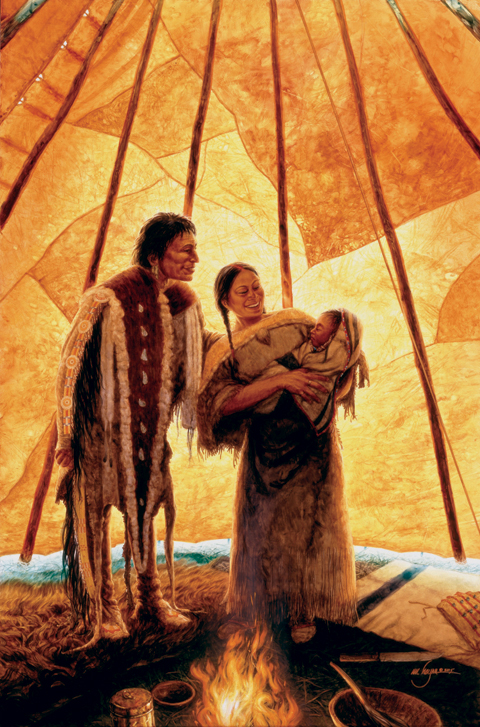
Watercolor, 24 by 36 inches, © 2006 Michael Haynes. Reproduction prohibited without artist’s permission, www.mhaynesart.com.
A major discrepancy among the accounts of Sacagawea’s[1]The authors use Sacagawea as the de facto spelling unless discussing the spellings associated with Hebard’s Shoshone accounts life and death that significantly alters her story is the controversy over her tribal origins as either Lemhi Shoshone or Hidatsa-Crow. Records created by members of the Lewis and Clark Expedition claimed that Sacagawea was born to the Salmon-Eating Agaidika or Lemhi Shoshones, as does nearly every other contemporaneous written source. Despite this written documentation, the Hidatsas still claim Sacagawea was born Hidatsa-Crow and not Shoshone. They assume there was a mistake either in the interpretation process or through a deliberate lie created by Toussaint Charbonneau in order to secure employment with the expedition.[2]Sacagawea Project Board of the Mandan, Hidatsa & Arikara Nation, Our Story of Eagle Woman Sacagawea: They Got It Wrong (Orange, CA: Paragon Agency, 2021), 161–163.
The Hidatsas argue Sacagawea’s brother Cherry Necklace had “snake medicine,” and perhaps she did too, and this may have been misinterpreted to suggest membership in the “Snake” or Shoshone tribe.[3]Sacagawea Project, Eagle Woman, 103, 105. Another possible explanation they offered was when Charbonneau mentioned Cameahwait was Sacagawea’s Shoshone “brother” the captains assumed she was also Shoshone, without considering he might be a ceremonially adopted brother.[4]Sacagawea Project, Eagle Woman, 51. The Hidatsa oral histories, including the Strong Jaw account, support the idea of Sacagawea’s Hidatsa birth and subsequent capture by a Shoshone raiding party, reversing the capture story from what the captains understood.[5]Sacagawea Project, Eagle Woman, 20–27. Apart from oral histories, a few secondary sources also support the claim that Sacagawea was Hidatsa-Crow. One comes from Jean Baptiste’s obituary, which stated his mother was “a half breed of the Crow tribe.”[6]Sacagawea Project, Eagle Woman, 185. Statements by George B. Sanderson and James Beckwourth also identify Sacagawea as Crow.[7]Sacagawea Project, Eagle Woman, 171–73. All other written documentary evidence, however, supports her Shoshone origins.
Lemhi Shoshone Origin
The written documentation most unquestionably connected to Sacagawea comes from the expedition journals. When expedition members first met Sacagawea at the Knife River Villages, they reported that she “belonged to the Snake nation” and was from the Rocky Mountains.[8]William Clark, The Definitive Journals of Lewis & Clark, Gary Moulton, ed. (Lincoln: University of Nebraska Press, 2002), 3:232–339, 9:95. The captains hired Charbonneau at least in part with the expectation that one of his Shoshone wives would accompany them on their journey in order to interpret for them to help procure horses from the Shoshones.[9]Moulton, Journals, 3:327–28. Throughout the journey, the explorers believed Sacagawea was Shoshone, as they relied on her language abilities and knowledge of the Shoshones’ homeland, language, and customs.[10]Moulton, Journals, 4:415–17. If Charbonneau had lied to the captains about her tribal origins in order to obtain employment, he and Sacagawea must have taken that lie to an extreme, concocting convincing stories about her capture as a child and her Shoshone family connections. The explorers reported that she showed them the very spot in the river where she was taken by her captors, and they were moved by her reunion with another girl who had likewise been captured but later escaped.[11]Moulton, Journals, 9:191–92; 5:109–13. Her connection as sister of Shoshone chief Cameahwait may have been more than just ceremonial, and Lewis and Clark even met the man she had been betrothed to as a girl but who no longer wished to marry her because she had had a child with Charbonneau.[12]Moulton, Journals, 5:119–23.
If the specifics recorded by the explorers about Sacagawea’s childhood are not convincing enough to prove her Shoshone origins, they at least offer compelling evidence she had the ability to speak Shoshone as she successfully functioned as interpreter not only when the Expedition encountered Shoshones but on other occasions when Shoshone prisoners were found among other tribes. The captains did not necessarily need to bring a Shoshone along on the journey, but they did require a Shoshone speaker. Therefore, misrepresenting herself as a Shoshone would have been unnecessary so long as they knew she spoke the language.
After the Expedition, written sources continued to identify Sacagawea as Shoshone or Snake. Some examples include the baptism record of her son in St. Louis, in which the scribe did not attempt to write her name but rather noted her as a “sauvagesse de la nation des serpents.”[13]Robert J. Moore, Jr., “Pompey’s Baptism,” We Proceeded On 26:2 (February 2000): 11, lewisandclark.org/wpo/pdf/vol26no1.pdf. The Duke of Wurttemberg noted Jean Baptiste’s mixed French-Shoshone heritage, and Brackenridge recorded that the wife of Charbonneau was of the Snake or Shoshone nation.[14]Henry Marie Brackenridge, Journal of a Voyage Up the River Missouri; performed in Eighteen Hundred and Eleven, 2nd ed. (Baltimore: Coale and Maxwell, 1816), cited in Early Western Travels, 1748-1846, … Continue reading
Analysis of primary sources recorded closest to the time of the events strongly supports the contention that Sacagawea was born Lemhi Shoshone and then captured by the Hidatsas and then known as Sacagawea or Bird Woman.
Hidatsa-Crow Origin
The Hidatsa-Crow account of Sacagawea’s story differs not only in the account of her post-Expedition life, but also in her pre-Expedition life and tribal identity. According to her alleged grandson Bulls Eye and others of the Three Affiliated Tribes of the Mandan, Hidatsa, and Arikara nations, her name was “tSakakaweaish” and she was always Hidatsa, never Shoshone. They insist Lewis and Clark misunderstood her tribal identity owing to Charbonneau’s poor interpretation skills. They relate through oral tradition that Sacagawea was born around 1787 in a Hidatsa village as the daughter of a Hidatsa man named Smoked Lodge and a Crow woman named Otter Woman. Hidatsa oral histories suggest Sacagawea may have been captured by the Shoshones and then escaped back to her Hidatsa people, this interlude aiding her in her ability to understand and speak the Shoshone language.[15]According to the Strong Jaw account. Sacagawea Project, Eagle Woman, 20-27.
She then lived in Crow territory in the Yellowstone River Valley in Montana as a teenager until her marriage to a white man named “Shabonish” at age seventeen. After becoming his wife, the year before the Lewis and Clark Expedition arrived at the Knife River village, the two traveled west past the Three Forks of the Missouri River and across the Rocky Mountains. This journey afforded Sacagawea familiarity with some of the landmarks in Shoshone country. Either on this journey with Charbonneau or sometime before, she met with some Shoshones and became friends with a man whom she fondly referred to as a brother, although he was not related by blood. Bulls Eye’s account concludes that this man was Lemhi Shoshone Chief Cameahwait whom the expedition encountered in 1805 in Idaho and whom Sacagawea called her brother. Bulls Eye suggested that Charbonneau probably told the captains that Sacagawea had a Shoshone brother and knew the country there and that they mistakenly interpreted that to mean she was Shoshone by birth. According to Bulls Eye, however, “They got it wrong,” and everyone among the Hidatsas knew her Hidatsa origins and “they knew her father and mother too.”[16]Summary of Sacagawea’s grandson Bulls Eye account. Sacagawea Project, Eagle Woman, 48-51.
This is an extract from Maren C. Burgess and Jay H. Buckley, “Seeking Sacagawea: A Comparison of the Principal Accounts of the Birth, Life, and Death of Bird Woman”, We Proceeded On 35, no. 3 (August 2009), 8–19. We encourage the dedicated scholar to read the complete, original article at lewisandclark.org/wpo/pdf/vol49no3.pdf—Ed.
Notes
| ↑1 | The authors use Sacagawea as the de facto spelling unless discussing the spellings associated with Hebard’s Shoshone accounts |
|---|---|
| ↑2 | Sacagawea Project Board of the Mandan, Hidatsa & Arikara Nation, Our Story of Eagle Woman Sacagawea: They Got It Wrong (Orange, CA: Paragon Agency, 2021), 161–163. |
| ↑3 | Sacagawea Project, Eagle Woman, 103, 105. |
| ↑4 | Sacagawea Project, Eagle Woman, 51. |
| ↑5 | Sacagawea Project, Eagle Woman, 20–27. |
| ↑6 | Sacagawea Project, Eagle Woman, 185. |
| ↑7 | Sacagawea Project, Eagle Woman, 171–73. |
| ↑8 | William Clark, The Definitive Journals of Lewis & Clark, Gary Moulton, ed. (Lincoln: University of Nebraska Press, 2002), 3:232–339, 9:95. |
| ↑9 | Moulton, Journals, 3:327–28. |
| ↑10 | Moulton, Journals, 4:415–17. |
| ↑11 | Moulton, Journals, 9:191–92; 5:109–13. |
| ↑12 | Moulton, Journals, 5:119–23. |
| ↑13 | Robert J. Moore, Jr., “Pompey’s Baptism,” We Proceeded On 26:2 (February 2000): 11, lewisandclark.org/wpo/pdf/vol26no1.pdf. |
| ↑14 | Henry Marie Brackenridge, Journal of a Voyage Up the River Missouri; performed in Eighteen Hundred and Eleven, 2nd ed. (Baltimore: Coale and Maxwell, 1816), cited in Early Western Travels, 1748-1846, ed., Reuben Gold Thwaites (Cleveland: Arthur H. Clark Company, 1904), 32–33. |
| ↑15 | According to the Strong Jaw account. Sacagawea Project, Eagle Woman, 20-27. |
| ↑16 | Summary of Sacagawea’s grandson Bulls Eye account. Sacagawea Project, Eagle Woman, 48-51. |
Experience the Lewis and Clark Trail
The Lewis and Clark Trail Experience—our sister site at lewisandclark.travel—connects the world to people and places on the Lewis and Clark Trail.
Discover More
- The Lewis and Clark Expedition: Day by Day by Gary E. Moulton (University of Nebraska Press, 2018). The story in prose, 14 May 1804–23 September 1806.
- The Lewis and Clark Journals: An American Epic of Discovery (abridged) by Gary E. Moulton (University of Nebraska Press, 2003). Selected journal excerpts, 14 May 1804–23 September 1806.
- The Lewis and Clark Journals. by Gary E. Moulton (University of Nebraska Press, 1983–2001). The complete story in 13 volumes.
This site is provided as a public service by the
Lewis and Clark Trail Alliance
with additional funding from the following: