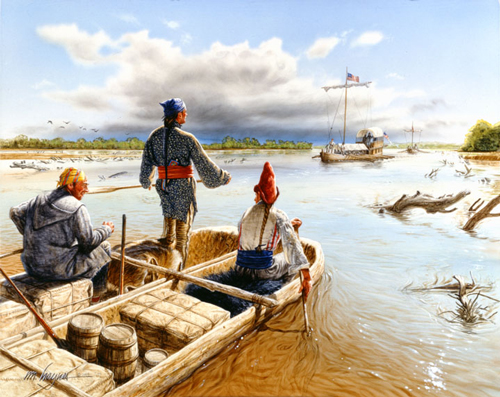
At first light, the three boats head up the Missouri. During the day, they meet three French traders who are out of provisions and powder. Clark explores the Lamine River and finds a cache of supplies and furs. At camp below Arrow Rock, rains prevent them from lighting their cooking fires.
An Island Called the Mills
by Yellowstone Public Radio[1]Originally aired weekdays by Yellowstone Public Radio during the Bicentennial observance of 2003-2006. Narrated by Hal Hansen. Scripts by Whit Hansen and Ed Jacobson. Produced by Leni Holliman. © … Continue reading
Three French Traders
© Michael Haynes, https://www.mhaynesart.com. Used with permission.
The Lamine River
passed the Mine River at 9 ms. this river is about 70 yards wide at its mouth and is Said to be navagable for Perogues 80 or 90 ms. the branch passes near the place where the Little osage Village formerly Stood on the Missouries, & heads between the Osarge & Kansias Rivers, the left hand fork head with nearer Branches of the Osage River, The french inform that Lead Ore has been found in defferent parts of this river
—William Clark
In his 1810 interview with Nicholas Biddle, Clark clarifies that he had explored by land and come down the Lamine River on this day. He added:
. . . in the Summer the west fork of Mine river is so much impregnated with salt that for nearly thirty miles the water is not palatable. Several branches of the Manitou & Good womans river, & the river Saline itself are equally tainted.
Black Raspberry

Photo ©2008 Alina Zienowicz. Permission via the Creative Commons 3.0 License.
Good Land
found the Countrey for one mile back good Land and well watered the hills not high with a gentle assent from the river, well timbered with oake, walnit Hickory ash, &c. the land Still further back becoms thin and open, with Black & rasp Berries, and Still further back the Plains Commence
—William Clark
Three French Traders
This day we met 3 men on a Cajaux from the River of the Soux above the Mahar [Omaha] nation those men had been hunting 12 mo: & made about 900$ in pelts. & furs they were out of Provesions and out of Powder.
—William Clark
“Cajue (kah-ZHO): A small raft consisting of logs or planks or two canoes lashed together.”[2]Alan H. Hartley, Alan H., Lewis & Clark Lexicon of Discovery (Pullman, WA: WSU Press, 2004), 32.
Cache Found
at this place I found Kanteens, Axs, Pumey Stone & peltrey hid & buried (I suppose by some hunters) none of them (except the pumey Stone) was teched by one of our party
—William Clark
Experience the Lewis and Clark Trail
The Lewis and Clark Trail Experience—our sister site at lewisandclark.travel—connects the world to people and places on the Lewis and Clark Trail.
Plan a trip related to June 8, 1804:
Notes
| ↑1 | Originally aired weekdays by Yellowstone Public Radio during the Bicentennial observance of 2003-2006. Narrated by Hal Hansen. Scripts by Whit Hansen and Ed Jacobson. Produced by Leni Holliman. © 2003 by Yellowstone Public Radio. |
|---|---|
| ↑2 | Alan H. Hartley, Alan H., Lewis & Clark Lexicon of Discovery (Pullman, WA: WSU Press, 2004), 32. |