On or near this date, Lewis and his crews pass the Little Miami River. Contemporary traveler Thomas Rodney describes the Little Miami and the Ohio rivers. At Columbia, they pass a Baptist Church symbolic of the high expectations of the town’s founders.[1]Due to the gap in Lewis’s journal, his exact location for this date is unknown. In a letter, he said he arrived in Cincinnati the next day, so a reasonable conjecture is that he stopped for the … Continue reading
Old Baptist Church at Columbia
c. 1835
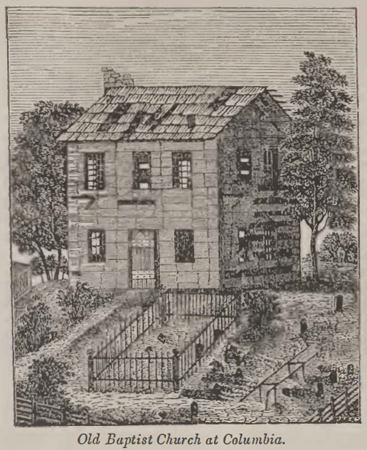
Colorized from the original in Henry Howe, Historical Collections of the Ohio, 1847.
Numerous Riffles
Above Columbia, Lewis encountered numerous riffles, no doubt slowing his progress. Thomas Rodney mentions several on this stretch of the river.
A mile below the last creek is a flat bar that spreads quite across the river with a riffle at the lower end. There was only 9 inches water on this bar. We kept the middle of the river. The current fell over the riffle towards the NW shore, and we crossed about half way, being guided by the current. At the lower end of the riffle there is a sand bar on the Kentucky shore . . . .
—Thomas Rodney, 7 October 1803[2]Dwight L. Smith and Ray Swick, ed., A Journey Through the West: Thomas Rodney’s 1803 Journal from Delaware to the Mississippi Territory (Athens: Ohio University Press, 1997), 100–01.
One can only imagine Lewis’s frustration trying move the barge—which draws over two feet of water—through a 9-inch-deep riffle.
Baptist Church in Columbia
Columbia and its church (see figure) existed when Lewis traveled down the Ohio in 1803. O. M. Spencer, who attended the church and lived in the town as early as 1790, describes the town’s unfilled promise:
It is, perhaps, unknown to many, that the broad and extensive plain stretching along the Ohio from the Crawfish to the mouth, and for three miles up the Little Miami, and now divided into farms, highly cultivated, was the ancient site of Columbia, a town laid out by Major Benjamin Stites, its original proprietor ; and by him and others once expected to become a large city, the great capital of the west.
—O. M. Spencer[3]Henry Howe, Historical Collections of Ohio; Containing a Collection of the Most Interesting Facts, Traditions, Biographical Sketches, Anecdotes Etc… (Cincinnati: Derby, Bradley & Co., … Continue reading
Little Miami River
At half past 3 P.M. we passed the mouth of the Little Miama. This is a handsome river about 70 or 80 yds. wide. There is a large sand bar at the mouth.
—Thomas Rodney, 7 October 1803[4]Rodney Journal, 101–102.
Rapids above Cincinnati
It is 8 miles from Little Miama to Licking, 7 from Cullumbia to Cincinnati. The river winds from the mouth of Miama round to SW in its course to Lycking and is at this time a rapid almost all the way.
—Thomas Rodney, 7 October 1803[5]Rodney Journal, 102.
Experience the Lewis and Clark Trail
The Lewis and Clark Trail Experience—our sister site at lewisandclark.travel—connects the world to people and places on the Lewis and Clark Trail.
Plan a trip related to September 27, 1803:
Notes
| ↑1 | Due to the gap in Lewis’s journal, his exact location for this date is unknown. In a letter, he said he arrived in Cincinnati the next day, so a reasonable conjecture is that he stopped for the night somewhere above Cincinnati. The settlement at the Little Miami River is a likely candidate and would allow for a Cincinnati arrival early tomorrow. |
|---|---|
| ↑2 | Dwight L. Smith and Ray Swick, ed., A Journey Through the West: Thomas Rodney’s 1803 Journal from Delaware to the Mississippi Territory (Athens: Ohio University Press, 1997), 100–01. |
| ↑3 | Henry Howe, Historical Collections of Ohio; Containing a Collection of the Most Interesting Facts, Traditions, Biographical Sketches, Anecdotes Etc… (Cincinnati: Derby, Bradley & Co., 1847), 229. |
| ↑4 | Rodney Journal, 101–102. |
| ↑5 | Rodney Journal, 102. |