After an early start, the enlisted men and engagés struggle to move the boats past the Blue River in present Kansas City, Missouri. At Kaw Point, the towrope breaks, and they are forced to row the barge (keelboat) to shore and encamp. In a later interview with Nicholas Biddle, Clark discusses the Carolina parakeets and Blue River seen this day.
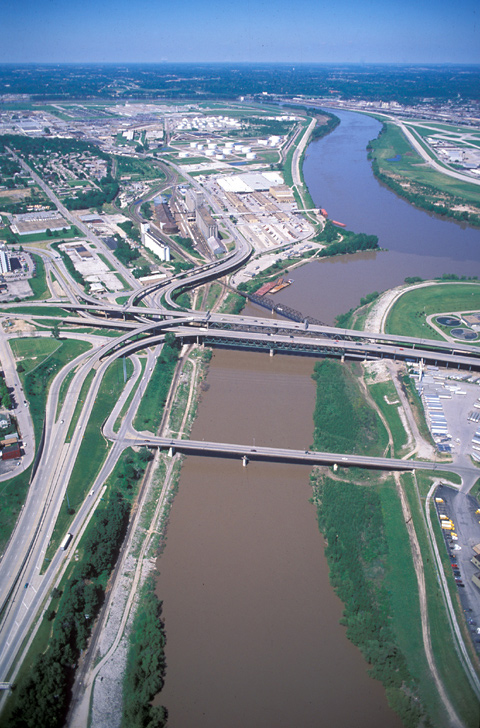
Above: This view looks northeast down the Kansas, then up the Missouri. Kaw Point is the small, green point of land at the confluence. For more, see The Kansas River by Air.
Hunting from the Boat
Got mighty hot Saw 3 deer Swiming Down the River the white peerogue took after them Killd. the three One of whom Sunk as Soon it Got Shot in the head Got the Other two Brought them Up to the Barge—
—Joseph Whitehouse
Kaw Point Difficulties
at this Place the river appears to be Confd. in a verry narrow Channel, and the Current Still more So by Couenter Current or Whirl on one Side & high bank on the other, passed a Small Isd. in the bend to the L. Side we Killed a large rattle Snake, Sunning himself in the bank passed a bad Sand bar, where our tow rope broke twice, & with great exertions we rowed round it and Came to & Camped in the Point above the Kansas River
—William Clark
Parakeets and Plaster of Paris
Passed the mouth of a Small river on the L. Side above the upper point of a Small Island, Called Blue water river
—Meriwether LewisI observed a great number of Parrot queets this evening
—William Clark
Consistent with Thomas Jefferson‘s original instructions, Clark later added:
A few miles up the Blue river are quarries of Plaster of Paris [gypsum] since worked & brought down to St. Louis. Parroquets a small kind of parrots.[1]“The Nicholas Biddle Notes” in Letters of the Lewis and Clark Expedition with Related Documents: 1783–1854, ed. Donald Jackson (Urbana: University of Illinois Press, 1978), 2:509.
This was the first mention of the Carolina parakeet (Conuropsis carolinensis Gmelin [con-your-OP-sis care-oh-lin-EN-sis] existing west of the Mississippi. The bird was also described by Peter Custis, the naturalist of the Freeman-Custis Expedition that began the year Lewis and Clark headed home. The birds are now extinct.[2]The Definitive Journals of Lewis & Clark, Gary Moulton, ed. (Lincoln: University of Nebraska Press, 2002), 2:325n3.
Experience the Lewis and Clark Trail
The Lewis and Clark Trail Experience—our sister site at lewisandclark.travel—connects the world to people and places on the Lewis and Clark Trail.
Plan a trip related to June 26, 1804:
Notes
| ↑1 | “The Nicholas Biddle Notes” in Letters of the Lewis and Clark Expedition with Related Documents: 1783–1854, ed. Donald Jackson (Urbana: University of Illinois Press, 1978), 2:509. |
|---|---|
| ↑2 | The Definitive Journals of Lewis & Clark, Gary Moulton, ed. (Lincoln: University of Nebraska Press, 2002), 2:325n3. |