In Paris, France, the French-language version of the Louisiana Purchase Treaty and Convention is signed. Robert Livingston writes to President Thomas Jefferson to tell him that New Orleans and Louisiana will soon belong to the United States.
Treaty Signing
Signing of the Louisiana Purchase Treaty
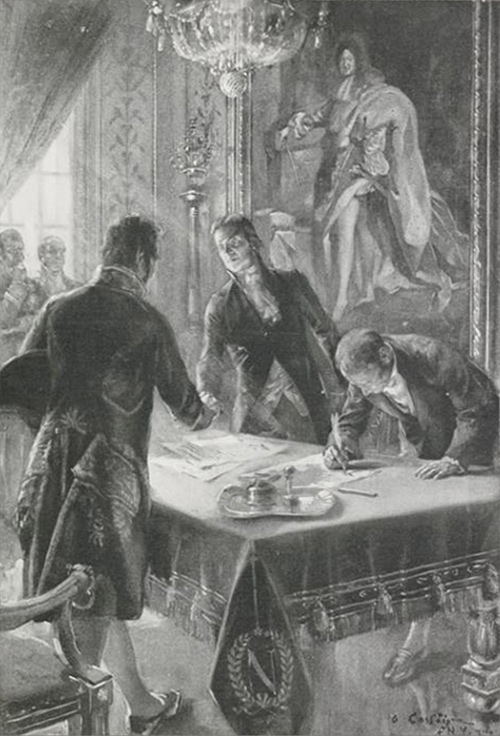
From the Century Illustrated monthly magazine, Vol. 68, no. 2, 1903–06. Provided by General Research Division, The New York Public Library.[1]“The signing of the Louisiana Purchase Treaty by Marbois, Livingston, and Monroe,” New York Public Library Digital Collections. Accessed 15 May 2022. … Continue reading
The treaty was dated 30 April 1803 but François Barbé-Marbois, James Monroe, and Robert Livingston signed it and its conventions over a series of days in May.
May 2d. We actually signed the treaty and convention for the sixty millions of Francs to France in the French language, but our copies in English not being made out we could not sign in our language. They were however prepared and signed two or three days afterwards. The convention respecting American claims took more time & was not signed till about the 8. or 9th.[2]“Journal or Memoranda—Louisiana” in Stanislaus Murray Hamilton, ed. The Writings of James Monroe, Vol IV, 1803–1806 (New York: G. P. Putman’s Sons, 1900), 4:17; available at … Continue reading
Louisiana is Ours
Paris 2 May 1803
Dear Sir [Thomas Jefferson]
Our affairs you may consider as compleatly finished they are arranged & we shall probably sign tomorrow New Orleans as it now is and as it was when France possessed it and Louisiana are ours
I am
Dear Sir with the most respectful consideration Your Most Obt hum: Servt
R R Livingston[3]Robert R. Livingston to Thomas Jefferson, Founders Online, National Archives, founders.archives.gov/documents/Jefferson/01-40-02-0224 accessed 1 June 2022. [Original source: The Papers of Thomas … Continue reading
Notes
| ↑1 | “The signing of the Louisiana Purchase Treaty by Marbois, Livingston, and Monroe,” New York Public Library Digital Collections. Accessed 15 May 2022. digitalcollections.nypl.org/items/9401f2b9-9343-4e23-e040-e00a180635d9. |
|---|---|
| ↑2 | “Journal or Memoranda—Louisiana” in Stanislaus Murray Hamilton, ed. The Writings of James Monroe, Vol IV, 1803–1806 (New York: G. P. Putman’s Sons, 1900), 4:17; available at archive.org/details/writingsjamesmo03monrgoog/. |
| ↑3 | Robert R. Livingston to Thomas Jefferson, Founders Online, National Archives, founders.archives.gov/documents/Jefferson/01-40-02-0224 accessed 1 June 2022. [Original source: The Papers of Thomas Jefferson, vol. 40, 4 March–10 July 1803, ed. Barbara B. Oberg. Princeton: Princeton University Press, 2013, pp. 301–304.] |
Experience the Lewis and Clark Trail
The Lewis and Clark Trail Experience—our sister site at lewisandclark.travel—connects the world to people and places on the Lewis and Clark Trail.

Discover More
- The Lewis and Clark Expedition: Day by Day by Gary E. Moulton (University of Nebraska Press, 2018). The story in prose, 14 May 1804–23 September 1806.
- The Lewis and Clark Journals: An American Epic of Discovery (abridged) by Gary E. Moulton (University of Nebraska Press, 2003). Selected journal excerpts, 14 May 1804–23 September 1806.
- The Lewis and Clark Journals. by Gary E. Moulton (University of Nebraska Press, 1983–2001). The complete story in 13 volumes.
This site is provided as a public service by the

Lewis and Clark Trail Alliance
with additional funding from the following: