On the advice of his pilot, Lewis heads down the Ohio before the morning fog has cleared. After seven miles, they anchor on a large sandbar opposite Old Town Creek and above present Millwood, West Virginia. Lewis finds it a good place to open and dry the goods, and he finds rust on the guns, tomahawks, and knives; and biscuits that are ‘much injured’.
An Early Stop
The morning was foggy but bing informed by my pilot that we had good water for several miles I ventured to set out before the fog disappeared; came on seven miles to the old Town Bar, which being a handsome clean place for the purpose I determined to spend the day and to open & dry my goods . . . .
—Meriwether Lewis
Rusty Iron
Rusty Tomahawk
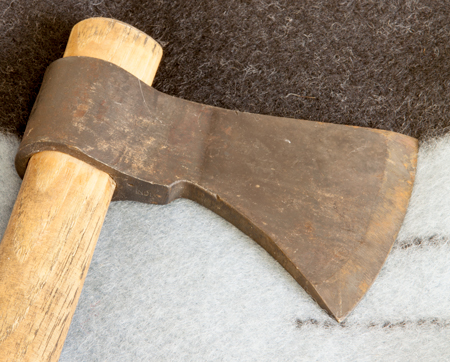
© 2013 Kristopher K. Townsend. Permission to use granted under the Creative Commons Attribution-Share Alike 4.0 International license.
At this point in the journey, the tomahawks would only include the heads. Their handles would be made and added as needed.
I found on opening the goods that many of the articles were much Injured; particularly the articles of iron, which wer rusted very much my guns, tomehawks, & knives were of this class; I caused them to be oiled and exposed to the sun the clothing of every discription also was opened and aired, we busily employed in this business all hands
—Meriwether Lewis
Injured Biscuits
my bisquit was much injurd I had it picked and put up in these baggs—this work kept so busy that I ate not any thing untill after dark, being determined to have every thing in readiness for an early start in the morning;
—Meriwether Lewis
Lewis’s soggy biscuits were likely what we call today hardtack. Hardtack can last for several years—as long as it doesn’t get wet or become infested with vermin. Lewis doesn’t tell us which type of injury the biscuits received, but it appears he was picking out vermin until after dark.
Upstream Winds
between the riffles and in many places for several miles together there is no preseptable courent, the whole surface being perfectly dead or taking the direction only which the wind may chance to give it, this makes the passage down this stream more difficult than would at first view be immageoned, when it is remembered also that the wind so frequently sets up the river the way the traveler makes in descending therefore is by the dint of hard rowing—or force of the oar or pole.
—Meriwether Lewis
Floating Mill
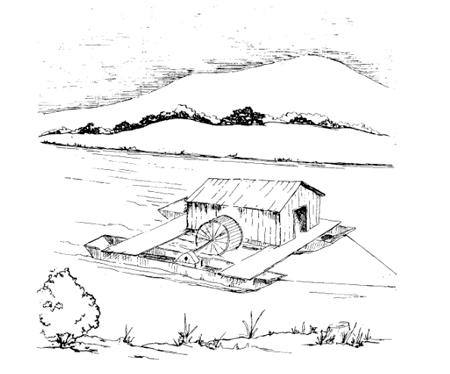
© 1980 Society for Landscaping, Place & Material Culture.
Floating Mill
When passing this same stretch of river just a few days behind Lewis, Rodney mentions a floating mill between the Little Sandy and Ravenswood:
[W]e passed a floating mill anchored in the river. She was placed on a flat or scow and a canoe without it for the axes of the water wheel to lodge on; and both were connected and held together by a frame of square logs above and below.
—Thomas Rodney (26 September 1803)[1]Dwight L. Smith and Ray Swick, ed., A Journey Through the West: Thomas Rodney’s 1803 Journal from Delaware to the Mississippi Territory (Athens: Ohio University Press, 1997), 76.
Griffin Greene, who helped establish Marietta, had seen floating mills in France and Holland, and thought they could solve the problem of pioneers unable to safely reach mills during the Indian war of 1791. Captain Jonathan Devoll, when given their description, constructed such a mill. Besides the Ohio, they were known to be on the Little Miami, Scioto, Hocking, and Muskingum Rivers.[2]International Society for Landscaping, Place & Material Culture. “Cruising Down the River . . . in a Gristmill.” Pioneer America (1980), 115.
Experience the Lewis and Clark Trail
The Lewis and Clark Trail Experience—our sister site at lewisandclark.travel—connects the world to people and places on the Lewis and Clark Trail.
Plan a trip related to September 17, 1803:

Notes
| ↑1 | Dwight L. Smith and Ray Swick, ed., A Journey Through the West: Thomas Rodney’s 1803 Journal from Delaware to the Mississippi Territory (Athens: Ohio University Press, 1997), 76. |
|---|---|
| ↑2 | International Society for Landscaping, Place & Material Culture. “Cruising Down the River . . . in a Gristmill.” Pioneer America (1980), 115. |