In Pittsburgh, completion of the expedition’s barge is about half a month away. Just like the enlisted men during the upcoming expedition, the town’s residents and even the dogs and goats suffer from tumors and wens—what Lewis would call “boils and imposthumes”.
“Pittsburgh in 1790”
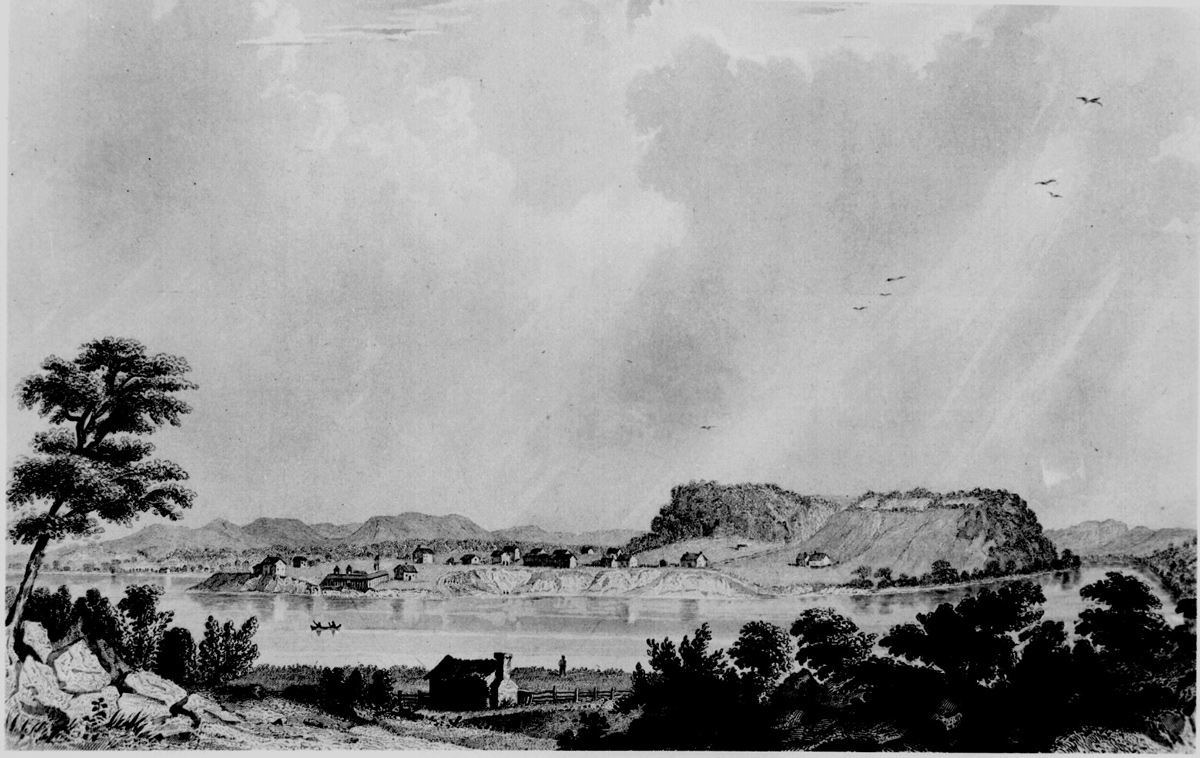
Generated from the original engraving in Henry R. Schoolcraft, Information Respecting the History, Condition and Prospects of the Indian Tribes of the United States, 1854, available at the National Archives Catalog.
Tumors and Wens
We observed several people near Pittsburg affected with a tumour on the throat like a wen. Inquiring into the cause of it, we were informed that they imputed it to some effect of the climate under the brows of the high mountains where they reside, and added that even dogs and some other animals were subject to it. Indeed we saw a couple of goats who had this uncomfortable appendage to their necks.
—Thaddeus Harris[1]Thaddeus Harris, The Journal of a Tour into the Territory Northwest of the Alleghany Mountains Made in the Spring of the Year 1803, p. 45–46 in Reuben G. Thwaites, Travels West of the Alleghanies … Continue reading
Defining “Wen”
Owen Dictionary, which was brought on the expedition, gives this definition for Wen:
WEN, a tumour or excrescence that arises on different parts of the body, and contains a cystus, or bag filled with some peculiar matter, of which physicians reckon three kinds, viz. when this matter is soft, resembling pulp, the wen is called atheroma; if like honey, meliceris; and if like suet, steatoma.[2]A Dictionary of Arts and Sciences, Owens 1764 ed., s.v. “wen.”
Experience the Lewis and Clark Trail
The Lewis and Clark Trail Experience—our sister site at lewisandclark.travel—connects the world to people and places on the Lewis and Clark Trail.
Plan a trip related to August 16, 1803:
Notes
| ↑1 | Thaddeus Harris, The Journal of a Tour into the Territory Northwest of the Alleghany Mountains Made in the Spring of the Year 1803, p. 45–46 in Reuben G. Thwaites, Travels West of the Alleghanies (Cleveland: The Arthur H. Clark Co., 1904), p. 346. |
|---|---|
| ↑2 | A Dictionary of Arts and Sciences, Owens 1764 ed., s.v. “wen.” |