On this date, Lewis, Clark, and the Osage and Mandan delegations[1]For the delegations traveling with Lewis and Clark on this day, see The Osage Delegations and Sheheke’s Delegation. leave the Barrens and climb the Silver Hills that overlook Clark’s hometown, Louisville. His brother notes their arrival at the Falls of the Ohio.
Back in St. Louis, problems with French and Spanish land titles mount as the former Surveyor General writes his defense against the unfavorable review he received when Lewis and Clark inspected his books of plots and surveys.
Silver Hills
Albany, Indiana
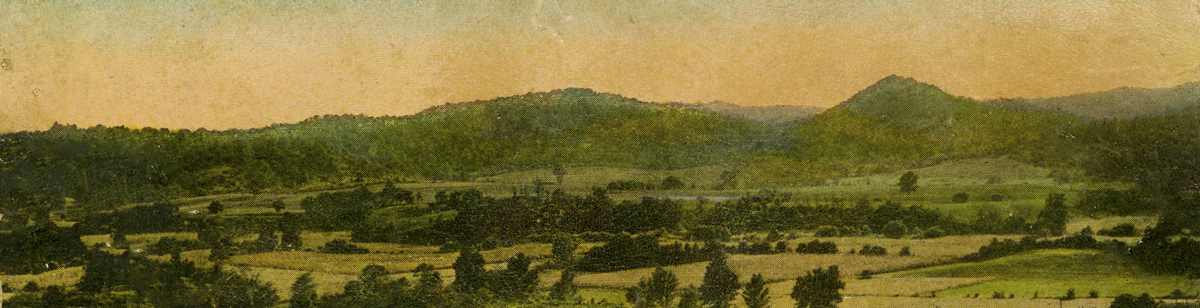
Photo courtesy of Stuart B. Wrege Indiana History Room – New Albany-Floyd County Public Library. Permission to use granted under the Creative Commons Attribution-ShareAlike 2.0 Generic (CC-BY-SA 2.0) license.
Home in View
On his return from Vincennes as a soldier in Captain Hardin’s militia, Clark noted the view of home from atop the Silver Hills.
After leaving those Barrons for 10 miles wa[s] good Land then we mounted the Silver Knobs from the top of which may be seen Louisville W[e] came down those knobs and then 4 miles father arrived at Clarksville.
—William Clark, August 1789[2]Journal of Hardin’s Campaign, 5 Aug 1789–5 Mar 1790, William Clark Papers, Missouri Historical Society.
Falls of the Ohio
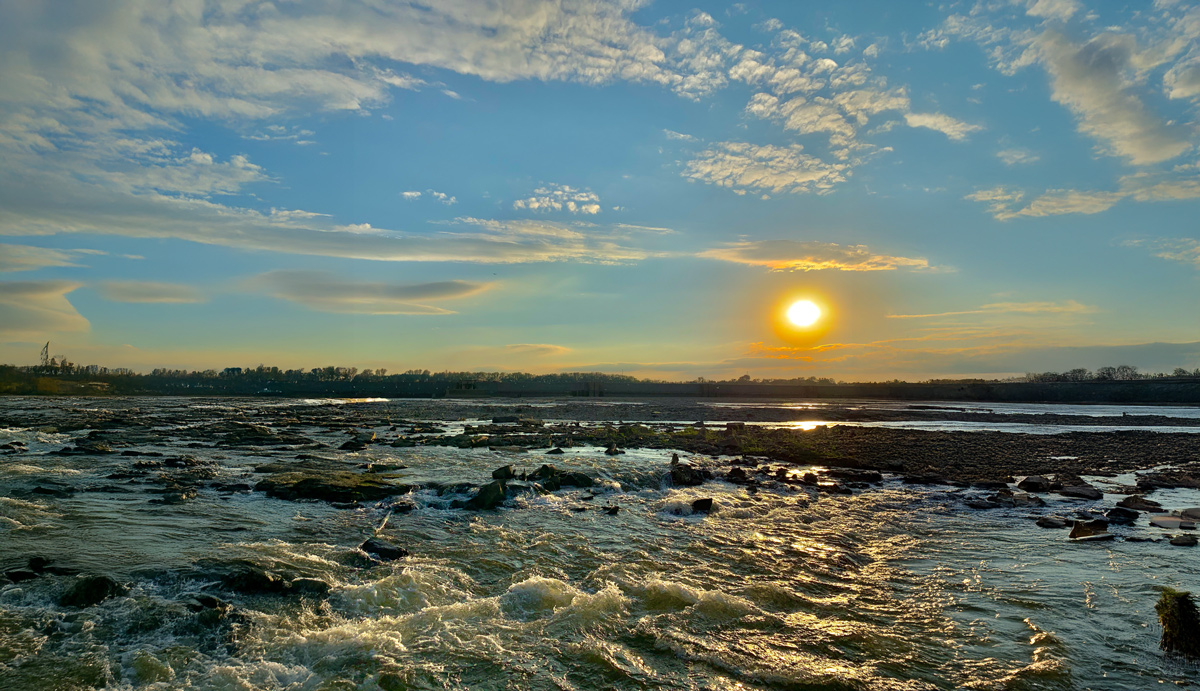
Digital approximation based on an existing photograph.
The Miami name for a buffalo road is Lan-an-zo-ki-mi-wi. Since the Pleistocene, the Falls of the Ohio was one of the few places where the Ohio River could be crossed, first by megafuana, then buffalo and Native Americans. These wide traces through the wilderness were the “the Appian Way of Illinois”. At the falls, several trails converged and then diverged, and Lewis, Clark, and the Osage delegation would soon follow separate traces on their way to Washington City.[3]George R. Willson, “Early Indiana Trails and Surveys”, Indiana Historical Society Publications, 6 no. 3 (1919): 349, 369; Archer Butler Hulbert, Historic Highways of America: Military … Continue reading
Clark’s Homecoming
Captains Lewis & Clark arrived at the Falls on their return from the Pacific Ocean after an absence of a little more than three years.
—Jonathan Clark[4]Jonathan Clark Diary, Clark-Hite Collection, The Filson Historical Society, Louisville, Kentucky.
Soulard’s Defense
To the Honorable Board of the Commissioners of the United States for the Examination of the Land Titles in the Territory of Louisiana,
Gentlemen,
The moment when I thought my Situation had ceased to attract the notice of my ill-wishers, was the moment they have chosen to disturb my retirement & my peace of mind. I am informed that an attempt has been made to prepossess against me Persons of respectability and whose opinion was esteem’d influential: It is before Capts Lewis & Clarke that my official conduct under the Spanish Government has been traduced and represented in the most unfavorable point of view.—The Books containing the Plots of the Surveys, which constitute what was always known under the appellation of Archive de l’arpentage; which books I have delivered to the Honble. Board upon their demand and are now in the possession of the Deputy principal Mr Silas Bent, those Books have been shewn & exhibited to the two Gentlemen aforesaid, as full of inaccuracies, of altered dates, Spurious leaves, erroneous areas, &c. Which circumstance has imposed upon me the duty of presenting to the Honble. Board the following explanation concerning the manner in which said books were kept.—
I have the honor to remain with a profound respect Gentlemen, Your Most obedt & very Hble. Servt.
A.S.—D. [Antoine Soulard]
St Louis 5th November 1806.[5]Clarence E. Carter, The Territorial Papers of the United States (Washington, DC: United States Government Printing Office, 1949), 14:29–33, digitized by Google books.
Notes
| ↑1 | For the delegations traveling with Lewis and Clark on this day, see The Osage Delegations and Sheheke’s Delegation. |
|---|---|
| ↑2 | Journal of Hardin’s Campaign, 5 Aug 1789–5 Mar 1790, William Clark Papers, Missouri Historical Society. |
| ↑3 | George R. Willson, “Early Indiana Trails and Surveys”, Indiana Historical Society Publications, 6 no. 3 (1919): 349, 369; Archer Butler Hulbert, Historic Highways of America: Military Highways of America (Cleveland, Ohio: The Aurthur H. Clark Company, 1904), 13:36, Project Gutenberg ebook, www.mirrorservice.org/sites/ftp.ibiblio.org/pub/docs/books/gutenberg/4/1/1/6/41167/41167-h/41167-h.htm. |
| ↑4 | Jonathan Clark Diary, Clark-Hite Collection, The Filson Historical Society, Louisville, Kentucky. |
| ↑5 | Clarence E. Carter, The Territorial Papers of the United States (Washington, DC: United States Government Printing Office, 1949), 14:29–33, digitized by Google books. |
Experience the Lewis and Clark Trail
The Lewis and Clark Trail Experience—our sister site at lewisandclark.travel—connects the world to people and places on the Lewis and Clark Trail.
Discover More
- The Lewis and Clark Expedition: Day by Day by Gary E. Moulton (University of Nebraska Press, 2018). The story in prose, 14 May 1804–23 September 1806.
- The Lewis and Clark Journals: An American Epic of Discovery (abridged) by Gary E. Moulton (University of Nebraska Press, 2003). Selected journal excerpts, 14 May 1804–23 September 1806.
- The Lewis and Clark Journals. by Gary E. Moulton (University of Nebraska Press, 1983–2001). The complete story in 13 volumes.
This site is provided as a public service by the

Lewis and Clark Trail Alliance
with additional funding from the following: