When four Cheyennes arrive at Fort Mandan below the Knife River Villages, the captains give them a speech, tobacco, a flag, and demonstrations of many ‘curiosities’. They also give them a letter of warning to deliver to the Sioux and Arikaras.
A Warning for the Sioux
by Yellowstone Public Radio[1]Originally aired weekdays by Yellowstone Public Radio during the Bicentennial observance of 2003-2006. Narrated by Hal Hansen. Scripts by Whit Hansen and Ed Jacobson. Produced by Leni Holliman. © … Continue reading
Cheyenne
Edgar S. Paxson (1852-1919)
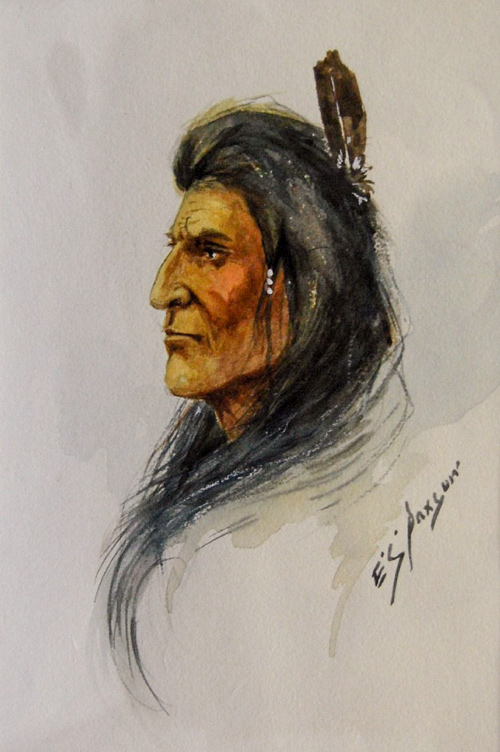
Meloy & Paxson Galleries; The University of Montana PARTV Center.
Mandans and Cheyennes
the Chiefs of the Lower village of the Mandans with maney of theire young men and 4 of the Shar-ha’s [Cheyennes] who had come to Smoke with the pipe of Peace with the Mandans, we explained to them our intentions our views and advised them to be at peace, Gave them a flag for theire nation, Some Tobacco with a Speech to Deliver to their nation on theire return
—William Clark
Arikara and Sioux Warnings
also Sent by them a letter to Mrs. Tabbo & Gravoline [Joseph Gravelines], at the Ricares [Arikara] Village, to interseid in proventing Hostilities, and if they Could not effect those measures to Send & informe us of what was going on, Stateing to the Indians the part we intend to take if the Rickores & Seauex [Sioux] did not follow our Derections and be at peace with the nations which we had addopted—
—William Clark
Weather Diary
Ther. at rise
Weather Wind at Thert. at 4 P.M. Weather Wind at 4 P.M. River 38 above fair N W. 36 fair N W raise 1 in. —Meriwether Lewis[2]To assist the reader, the editor of this web page has omitted the date column, merged the “River” columns, and spelled out some abbreviations.


Fort Mandan is a High Potential Historic Site along the Lewis and Clark National Historic Trail managed by the U.S. National Park Service. The North Dakota Department of Parks and Recreation manages a modern reconstruction and the Lewis and Clark Interpretive Center located at US Hwy 83 and ND Hwy 200A.
Knife River Indian Villages National Historic Site is a High Potential Historic Site along the Lewis and Clark National Historic Trail managed by the U.S. National Park Service. A unit of the National Park System, the site is located at 564 County Road 37, one-half mile north of Stanton, North Dakota. It has exhibits, trails, and a visitor center.
Notes
| ↑1 | Originally aired weekdays by Yellowstone Public Radio during the Bicentennial observance of 2003-2006. Narrated by Hal Hansen. Scripts by Whit Hansen and Ed Jacobson. Produced by Leni Holliman. © 2003 by Yellowstone Public Radio. |
|---|---|
| ↑2 | To assist the reader, the editor of this web page has omitted the date column, merged the “River” columns, and spelled out some abbreviations. |
Experience the Lewis and Clark Trail
The Lewis and Clark Trail Experience—our sister site at lewisandclark.travel—connects the world to people and places on the Lewis and Clark Trail.
This page was funded in part by the Lewis and Clark National Historic Trail, U.S. National Park Service.
Discover More
- The Lewis and Clark Expedition: Day by Day by Gary E. Moulton (University of Nebraska Press, 2018). The story in prose, 14 May 1804–23 September 1806.
- The Lewis and Clark Journals: An American Epic of Discovery (abridged) by Gary E. Moulton (University of Nebraska Press, 2003). Selected journal excerpts, 14 May 1804–23 September 1806.
- The Lewis and Clark Journals. by Gary E. Moulton (University of Nebraska Press, 1983–2001). The complete story in 13 volumes.
This site is provided as a public service by the
Lewis and Clark Trail Alliance
with additional funding from the following: