Tabeau was an experienced trader who worked under Régis Loisel in 1802–1804. The Lewis and Clark Expedition met him on 9 October 1804 at the Arikara villages. His narrative, found in Tabeau’s Narrative of Loisel’s Expedition to the Upper Missouri, was ‘resurrected’ by Annie Heloise Abel in 1939. It contains valuable historical and ethnographical information.
Related Pages
Too Né (Eagle Feather)
Arikara guide and diplomat
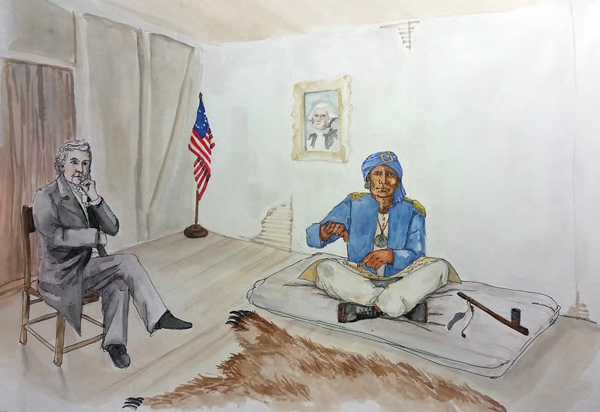
This Arikara leader rode upriver with the expedition in the weeks that followed to negotiate a peace settlement with the Mandan. In the spring of 1805 he went down river with the barge to St. Louis. After a series of delays, he went to Washington, DC, to meet with President Jefferson.
September 5, 1803
Canoes delayed
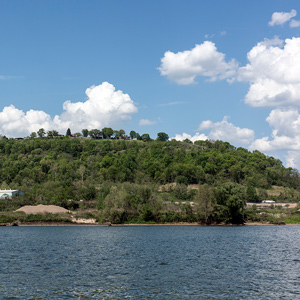
In present West Virginia, the Ohio River is deep enough to navigate without the help of horses or oxen. When the two canoes fail to arrive, the sounding horn is blown.
Already stationed on the Mississippi, the expedition’s future Sergeant of the Guard, John Ordway, writes home.
Up the Missouri River in present South Dakota, trader Pierre-Antoine Tabeau describes a diplomatic encounter among the Lakota, Omaha, and Ponca.
October 9, 1804
York's big medicine
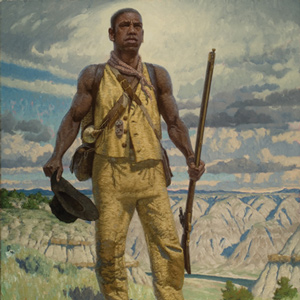
At Sawa-haini—an Arikara village near Mobridge, South Dakota—the planned council is delayed by weather. York fascinates the Arikara who apparently have never seen a black man before.
February 28, 1805
Arikara and Sioux news
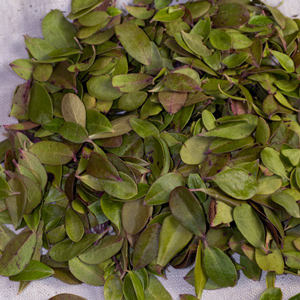
Traders arrive at the Knife River Villages with news and two plant specimens for Lewis. About six miles from Fort Mandan, several enlisted men cut down cottonwood trees to make dugout canoes.
March 5, 1805
The echinicea plant
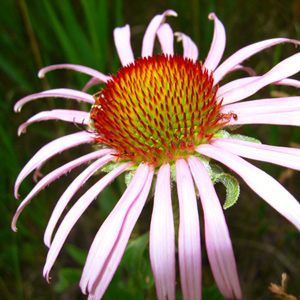
The day at Fort Mandan is warm. A letter is sent to trader Pierre-Antoine Tabeau staying nearby with some Arikaras, and Lewis writes a letter to President Jefferson describing the echinacea plant.
April 7, 1805
Leaving Fort Mandan
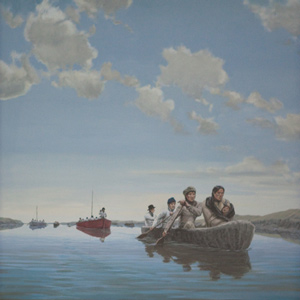
The permanent party—under Capts. Lewis and Clark—leaves Fort Mandan in six dugout canoes and two larger pirogues bound for the Pacific Ocean. They make it only as far as Mitutanka, one of the Knife River Villages. The return party—under Cpl. Warfington—takes the barge and one canoe down the Missouri headed for St. Louis.
In Washington City, James Wilkinson writes to James Madison, United States Secretary of State, accepting his appointment as Governor of Louisiana Territory.
September 21, 1806
St. Charles hospitality
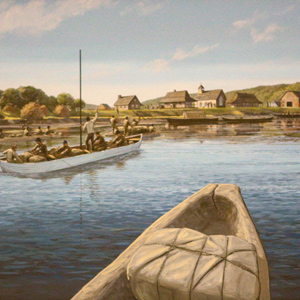
The boatmen paddle and row the 48 miles from La Charrette to St. Charles. They are greeted by the latter’s citizens with great cheer and hospitality. Lewis starts a letter to President Jefferson.
Experience the Lewis and Clark Trail
The Lewis and Clark Trail Experience—our sister site at lewisandclark.travel—connects the world to people and places on the Lewis and Clark Trail.
Discover More
- The Lewis and Clark Expedition: Day by Day by Gary E. Moulton (University of Nebraska Press, 2018). The story in prose, 14 May 1804–23 September 1806.
- The Lewis and Clark Journals: An American Epic of Discovery (abridged) by Gary E. Moulton (University of Nebraska Press, 2003). Selected journal excerpts, 14 May 1804–23 September 1806.
- The Lewis and Clark Journals. by Gary E. Moulton (University of Nebraska Press, 1983–2001). The complete story in 13 volumes.
This site is provided as a public service by the

Lewis and Clark Trail Alliance
with additional funding from the following: