During the night, the French engagés and a lost hunter arrive at camp. In the morning, all the boats are moved another fourteen miles up the Missouri before everyone stops near present Chamois, Missouri. Lewis collects a specimen of River-bank grape—now lost.
River-bank Grape
Vitis riparia
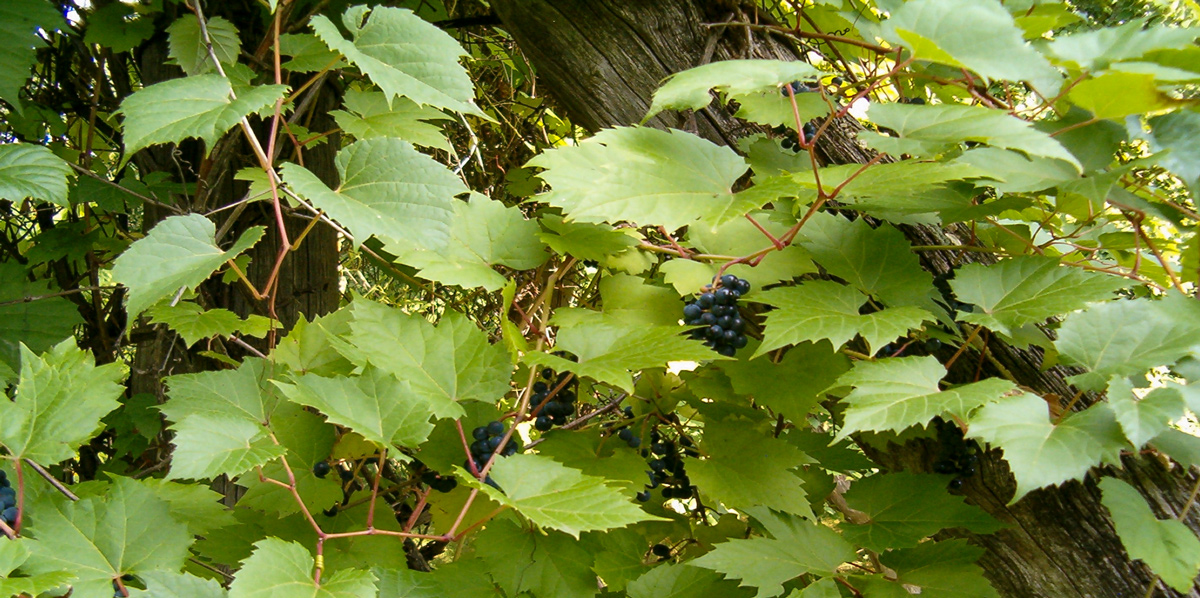
Photo by WikiCommons user BotBln, September 2006. Walter Siegmund. Permission to use granted under the Creative Commons Attribution-ShareAlike 3.0 Unported license.
Lost Hunter
Set out at 7 oClock after a heavy rain, rained all last night, a little after Dark last night Several guns were herd below, I expect the French men fireing for Whitehous [Joseph Whitehouse] who was lost in the woods.
—William Clark
Trees, Grapes, and Rushes
Here the soil is good, with cotton wood, sycamore, oak, hickory, and white walnut; with some grape vines, and an abundance of rushes.
—Patrick Gass
River-bank Grape
No. 9. Was taken on the 30th of May 1804 below the mouth of the Osage river; it rises from 18 Inches to 2 feet in hight; is a beautifull green plant found most generally on the sides of rich hills in the forrest it’s radix is fiberous—
—Meriwether Lewis
This lost specimen, received by John Vaughn in 1805 (see The Donation Book), remains unidentified.[1]Gary E. Moulton, ed. Journals, “Fort Mandan Miscellany”, vol 3:453, 467.
Weather Diary
Mulburies begin to ripen, very abundant in the bottom
—Meriwether Lewis
Experience the Lewis and Clark Trail
The Lewis and Clark Trail Experience—our sister site at lewisandclark.travel—connects the world to people and places on the Lewis and Clark Trail.
Plan a trip related to May 30, 1804:

Notes
| ↑1 | Gary E. Moulton, ed. Journals, “Fort Mandan Miscellany”, vol 3:453, 467. |
|---|