From his museum in Philadelphia, Charles Willson Peale writes to President Jefferson regarding the physiognotrace that can be used to draw portraits and the polygraph that can write a copy as an original is being written. He also announces his essay on preserving health.
Polygraph
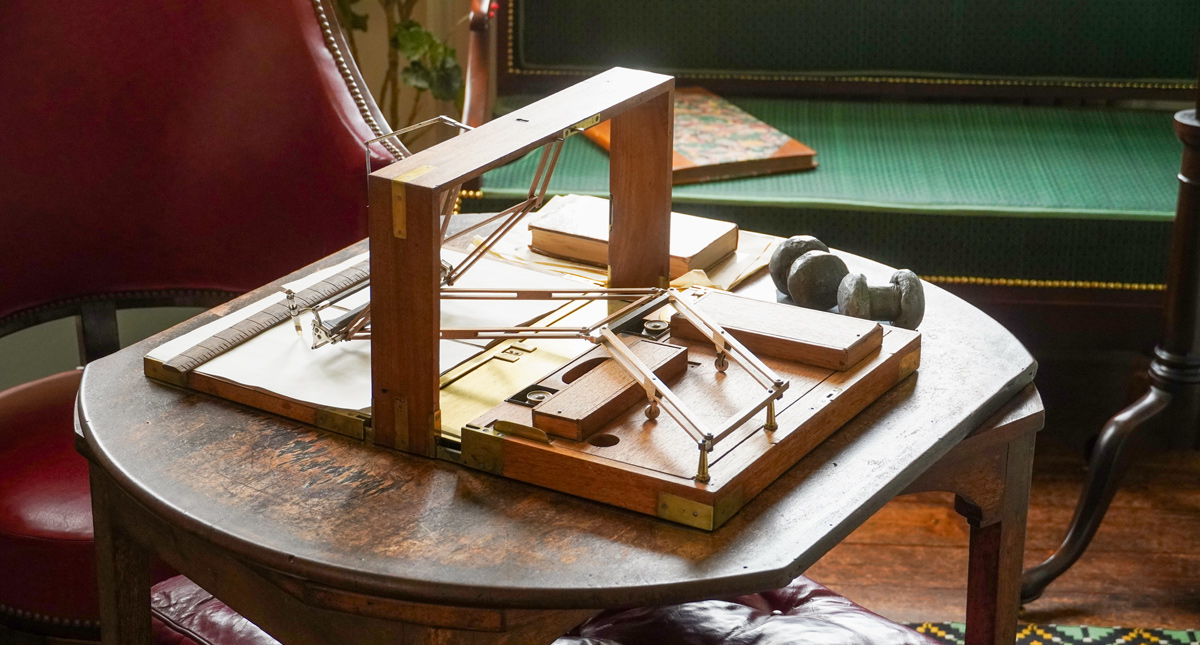
© 2022 by WikiMedia Commons user Henrysz. Permission to use granted under the Creative Commons Attribution-Share Alike 4.0 International license.
The above polygraph was on display at Jefferson’s home, Monticello.
The Polygraph
Museum Jany. 28th. 1803.
Dear Sir
His [Hawkins] invention of the Polygraph, appears to me to possess many advantages over the copying-press—common Ink, and common paper, without any preparation, such as weting &c—Several originals may be wrote at once, without any considerable labour or restraint on the fingers. The machine patented before, is I beleive perfectly useless—Monsr. Chaudron (watch maker 3d Street) who possesses one, is of the same opinion. As soon as Mr. Hawkins returns and obtains his Patent, he will I beleive find it his interest to promote a manufactory of them.[1]Charles Willson Peale to Thomas Jefferson, The Papers of Thomas Jefferson, vol. 39, 13 November 1802–3 March 1803, ed. Barbara B. Oberg (Princeton: Princeton University Press, 2012), 406–408, … Continue reading
Hawkins’ Physiognotrace
The Physiognotrace invented by Mr. Hawkins is made strong, because subject to be handled by all sorts of People that visit the Museum—The enclosed drawing and explanation of it, is rough, but correct—and I hope will give you a perfect Idea of all the essential parts of it. Mr. Hawkins has also contrived another Index, which is designed to give the lines of a ¾ face; the lines of the hair, eyes, eyebrows &c.[3]Charles Willson Peale to Thomas Jefferson, The Papers of Thomas Jefferson, 406–408.
Peale’s Essay on Preserving Health
I have wrote an essay on the means of preserving health and long life, which will be put to the press shortly. it may do good by opening the Eyes of some, who appear blind, or heedless of themselves—If some good is thereby promoted, I shall be satisfied.
I wish you every happiness and am with much respect your friend
C W Peale[4]Ibid.
Notes
| ↑1 | Charles Willson Peale to Thomas Jefferson, The Papers of Thomas Jefferson, vol. 39, 13 November 1802–3 March 1803, ed. Barbara B. Oberg (Princeton: Princeton University Press, 2012), 406–408, founders.archives.gov/documents/Jefferson/01-39-02-0352-0001, accessed 14 Dec 2025. |
|---|---|
| ↑2 | Lillian B. Miller, ed., The Selected Papers of Charles Willson Peale and His Family, (New Haven: Yale University Press, 1983–2000), 5:310-11. |
| ↑3 | Charles Willson Peale to Thomas Jefferson, The Papers of Thomas Jefferson, 406–408. |
| ↑4 | Ibid. |
| ↑5 | The epistle is available at National Library of Health Digital Collection, collections.nlm.nih.gov/catalog/nlm:nlmuid-2566045R-bk. |
Experience the Lewis and Clark Trail
The Lewis and Clark Trail Experience—our sister site at lewisandclark.travel—connects the world to people and places on the Lewis and Clark Trail.

Discover More
- The Lewis and Clark Expedition: Day by Day by Gary E. Moulton (University of Nebraska Press, 2018). The story in prose, 14 May 1804–23 September 1806.
- The Lewis and Clark Journals: An American Epic of Discovery (abridged) by Gary E. Moulton (University of Nebraska Press, 2003). Selected journal excerpts, 14 May 1804–23 September 1806.
- The Lewis and Clark Journals. by Gary E. Moulton (University of Nebraska Press, 1983–2001). The complete story in 13 volumes.
This site is provided as a public service by the

Lewis and Clark Trail Alliance
with additional funding from the following: