In Washington City, Isaac Briggs tells Thomas Jefferson that the fossils collected in 1803 by Meriwether Lewis at Big Bone Lick have been lost. In St. Louis, Lewis fills out two bill of exchange forms for area merchants.
Fossil from Big Bone Lick (1807)
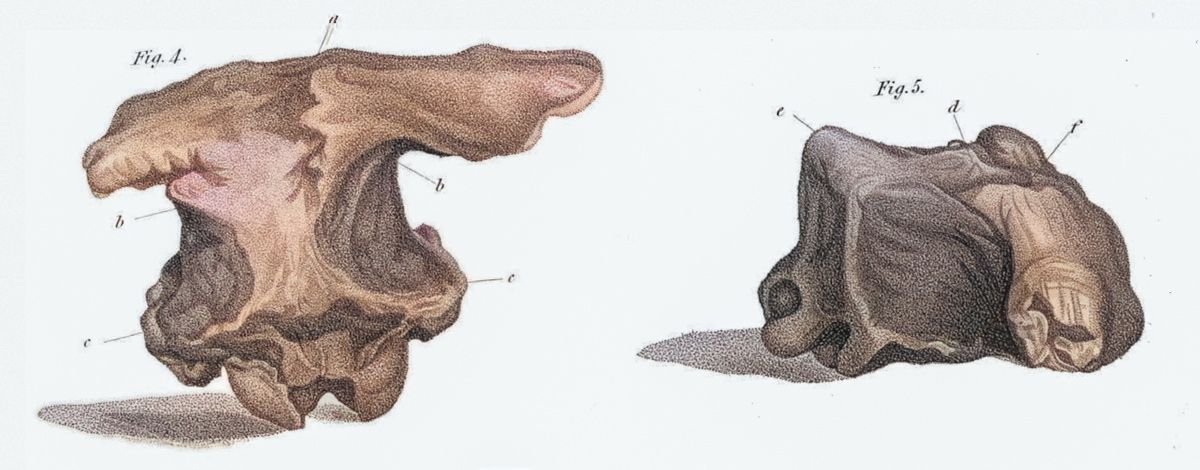
Caspar Wistar, Account of Heads, Plate X.
Specimens Irrecoverably Lost
Washington M.T. 27 of the 9 mo. 1806.
My dear friend,
. . . . .
The bones sent to Natchez by Capt Lewis are, I believe, irrecoverably lost. I am thy grateful and affectionate freind,
Isaac Briggs.[1]Isaac Briggs to Thomas Jefferson, “Founders Online”, National Archives, founders.archives.gov/documents/Jefferson/99-01-02-4320.
Jefferson’s desire to have fossils from Big Bone Lick did not fare will. After Lewis collected several specimens—including a large mastodon tusk—on his way down the Ohio in 1803, he had them shipped to Jefferson by way of river boat to New Orleans, then transferred to a packet boat that would carry them up the east coast. The river boat sank in the Mississippi at Natchez. The few boxes that were saved were thrown ashore and left unattended, later to be rifled by Tennessee militiamen then in Natchez, who discarded the contents. Subsequently, Dr. Goforth himself shipped ten crates of specimens from the famous Kentucky fossil bed to Jefferson, but it was somehow sent to England, where a swindler sold the treasures.[2]Landon Y. Jones, William Clark and the Shaping of the West (New York: Hill and Wang, 2004), 160.
In 1807, William Clark intervened. By that time, most of the large bones had already been found. Nevertheless, in Philadelphia, Caspar Wistar analyzed the two skulls shown in the figure above:
Being satisfied that the morass near the falls of Ohio, called the Big Bone Lick, still contained many animal remains which were worthy of attention, [President Jefferson] engaged General Wm. Clarke, who is so honourably known to the world by his Journey to the Pacific Ocean, to explore it, and furnished him with all the means necessary for so expensive an undertaking.
Gen. Clarke accomplished the business committed to him with great promptitude, and procured several large boxes of bones.—
The figure 4, exhibits the upper and posterior surfaces of the cranium and horns, as they appear when the head is viewed from behind. The figure 5, represents a profile view. . . . If it belonged to the genus Cervus [Elk], it was one of the largest species of that genus.[3]Mr. Jefferson, and Caspar Wistar. “An Account of Two Heads Found in the Morass, Called the Big Bone Lick, and Presented to the Society, by Mr. Jefferson.” Transactions of the American … Continue reading
Bills of Exchange
On 1 and 3 November 1806, the War Department received four bills of exchange from Meriwether Lewis. Three of them are dated 27 September and likely reflect expenses incurred when the expedition returned to St. Louis.
Saint Louis Sept. 27, 1806. Advising a bill for $300 in favor of Hunt and Hankinson.[4]National Archives Catalog, Record Group 107: Records of the Office of the Secretary of War, Volume 3: January 3, 1806–April 12, 1808, L-72, catalog.archives.gov/id/294984174?objectPage=68, accessed … Continue reading
St. Louis Sept 27, 1806. Advising a draft of $300 in favor of Falconer and Comegys.[5]Two records each for $300, Ibid. L-74 and L-75.
Notes
| ↑1 | Isaac Briggs to Thomas Jefferson, “Founders Online”, National Archives, founders.archives.gov/documents/Jefferson/99-01-02-4320. |
|---|---|
| ↑2 | Landon Y. Jones, William Clark and the Shaping of the West (New York: Hill and Wang, 2004), 160. |
| ↑3 | Mr. Jefferson, and Caspar Wistar. “An Account of Two Heads Found in the Morass, Called the Big Bone Lick, and Presented to the Society, by Mr. Jefferson.” Transactions of the American Philosophical Society 1 (1818): 375-80. doi:10.2307/1004925. |
| ↑4 | National Archives Catalog, Record Group 107: Records of the Office of the Secretary of War, Volume 3: January 3, 1806–April 12, 1808, L-72, catalog.archives.gov/id/294984174?objectPage=68, accessed 19 December 2025. |
| ↑5 | Two records each for $300, Ibid. L-74 and L-75. |
| ↑6 | Letters of the Lewis and Clark Expedition with Related Documents: 1783–1854, ed. Donald Jackson (Urbana: University of Illinois Press, 1978), 1:349. |
Experience the Lewis and Clark Trail
The Lewis and Clark Trail Experience—our sister site at lewisandclark.travel—connects the world to people and places on the Lewis and Clark Trail.
Discover More
- The Lewis and Clark Expedition: Day by Day by Gary E. Moulton (University of Nebraska Press, 2018). The story in prose, 14 May 1804–23 September 1806.
- The Lewis and Clark Journals: An American Epic of Discovery (abridged) by Gary E. Moulton (University of Nebraska Press, 2003). Selected journal excerpts, 14 May 1804–23 September 1806.
- The Lewis and Clark Journals. by Gary E. Moulton (University of Nebraska Press, 1983–2001). The complete story in 13 volumes.
This site is provided as a public service by the
Lewis and Clark Trail Alliance
with additional funding from the following: