As Clark oversees the packing of corn, flour, and salt at Camp River Dubois, President Jefferson samples a new shipment of wine from Portugal. Pvt. Moses Reed is sent to St. Louis on errands and at Monticello, Jefferson writes instructions for Thomas Freeman’s expedition to explore the Red and Arkansas rivers.
Keg of Hulled Corn
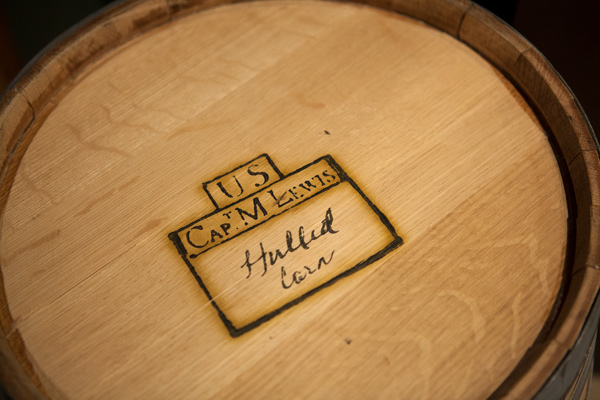
Taken with cooperation from the Fort Mandan Visitors’ Center. Photo © 2013 by Kristopher K. Townsend. Permission to use granted under the Creative Commons Attribution-Share Alike 4.0 International license.
St. Louis Errands
I sent Reed to St Louis with a letter & Some [Scerlet?] &c. Locks to be mended
—William Clark
Packing Provisions
I had finished off and packed up to day in part of my Store of Provisions—
13 Bags of Parched meal of 2 bus: each
9 do— Common Meal of N C— do
11 do & 3 barrels of N: Corn Huled do
3 do: & 30 —½ do—of Flour— do
7 Barrels of Salt of 2 ½ bushels each— do
—William Clark
Weather Diary
Thermometr. at rise
Weather Wind at Sunrise Thermometr. at 4 oClock Weather Wind at 4 oClock River 30 above 0 fair S W fair fall 5 in. —William Clark[1]To assist the reader, the editor of this web page has omitted the date column, merged the “River” columns, and spelled out some abbreviations.
Jefferson’s Instructions
Before the Lewis and Clark Expedition began their journey up the Missouri, Thomas Jefferson had drafted instructions for exploring the Red and Arkansas Rivers. Thomas Freeman would later be selected to lead the expedition, and he was presented a signed copy of these instructions in November 1805.
[April 14, 1804]
To
The government of the US. being desirous of informing itself of the extent of the country ceded to them under the name of Louisiana to have the same with it’s principal rivers geographically delineated to learn the character of the soil climate productions and inhabitants you are appointed to explore for these purposes the interesting portion of it which lies on the Arkansa and Red rivers from their confluence with the Missisipi to the remotest source of the main stream of each, and the highlands connecting the same, and forming a part of the boundary of the province.
Given under my hand and seal at Monticello this 14th day of April 1804….
Th: Jefferson[2]Transcribed from Freeman’s personal copy by Daniel L. Flores in Southern Counterpart with Lewis & Clark: The Freeman & Custis Expedition of 1806 (Norman, Oklahoma: University of … Continue reading
Jefferson’s New Wine
[April 14.] Inclosed the said note for 42.42 to Messrs. Smith & Buchanan of Baltimore for duties, freight from Lisbon & porterage of two hhds. of wine d’Oeyras sent me by Mr. Jarvis.[3]“Memorandum Books, 1803,” Founders Online, National Archives, founders.archives.gov/documents/Jefferson/02-02-02-0013 accessed 8 February 2026. [Original source: The Papers of Thomas … Continue reading
Jefferson recorded several shipments of Portuguese wine sent by William Jarvis—U.S. consul at Lisbon—between January 1803 and October 1805. He found the d’Oeyras [Oieras?] too sweet and asked for his favorite “Termo”. According to his list, he was sent Carrasqueira. The Carrasqueira whites from southern Portugal are known to be dry and crisp. He also received wine from the Arruda region just north of Lisbon. Today that region is known for its soft, red wines.[4]Ibid.;”Thomas Jefferson to William Jarvis, 10 May 1803,” Founders Online, National Archives, founders.archives.gov/documents/Jefferson/01-40-02-0261. [Original source: The Papers of … Continue reading
Experience the Lewis and Clark Trail
The Lewis and Clark Trail Experience—our sister site at lewisandclark.travel—connects the world to people and places on the Lewis and Clark Trail.
Plan a trip related to April 14, 1804:


Winter Camp at Wood River (Camp Dubois) is a High Potential Historic Site along the Lewis and Clark National Historic Trail managed by the U.S. National Park Service. The site, near Hartford, Illinois, is managed as Lewis and Clark State Historic Site and is open to the public.
In present St. Louis, the Jefferson National Expansion Memorial “commemorates Thomas Jefferson’s vision of the continental expansion of the United States” and is a High Potential Historic Site along the Lewis and Clark National Historic Trail managed by the U.S. National Park Service.
Notes
| ↑1 | To assist the reader, the editor of this web page has omitted the date column, merged the “River” columns, and spelled out some abbreviations. |
|---|---|
| ↑2 | Transcribed from Freeman’s personal copy by Daniel L. Flores in Southern Counterpart with Lewis & Clark: The Freeman & Custis Expedition of 1806 (Norman, Oklahoma: University of Oklahoma Press, 1984), 319–325. An alternate draft is available at www.loc.gov/item/mtjbib013365/. |
| ↑3 | “Memorandum Books, 1803,” Founders Online, National Archives, founders.archives.gov/documents/Jefferson/02-02-02-0013 accessed 8 February 2026. [Original source: The Papers of Thomas Jefferson, Second Series, Jefferson’s Memorandum Books, vol. 2, ed. James A Bear, Jr. and Lucia C. Stanton (Princeton: Princeton University Press, 1997), 1089–1117.] |
| ↑4 | Ibid.;”Thomas Jefferson to William Jarvis, 10 May 1803,” Founders Online, National Archives, founders.archives.gov/documents/Jefferson/01-40-02-0261. [Original source: The Papers of Thomas Jefferson, vol. 40, 4 March–10 July 1803, ed. Barbara B. Oberg (Princeton: Princeton University Press, 2013), 345–46.] |