At the Big Nemaha River, everyone has a break from the labor of moving the boats up the Missouri River. Pvt. Willard is tried and found guilty of sleeping while on guard duty, and Clark mentions wild grapes and cherries.
In Washington City, President Jefferson welcomes an Osage delegation organized in part by the captains during their time in St. Louis.
Willard Sleeping at his Post
by Yellowstone Public Radio[1]Originally aired weekdays by Yellowstone Public Radio during the Bicentennial observance of 2003-2006. Narrated by Hal Hansen. Scripts by Whit Hansen and Ed Jacobson. Produced by Leni Holliman. © … Continue reading
Cat-O-Nine-Tails
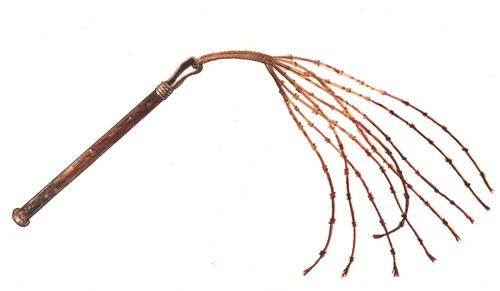
© Michael Haynes, https://www.mhaynesart.com. Used with permission.
Rest Day
our object in delaying here is to tak Some Observations and rest the men who are much fatigued made Sundery observations . . . . Latd. 39° 55′ 56″ N.
—William Clark
Ancient Graves
bottom land covered with Grass about 4½ feet high, the high lands which rose irregularly, & were toped with Mounds or antent Graves which is to me a Strong evidence of this Countrey haveing been thickly Settled—
—William Clark
Willard’s Charge and Plea
Alexander Willard was brought forward Charged with “Lying down and Sleeping on his post whilst a Sentinal, on the night of the 11th. Instant” (by John Ordway Sergeant of the Guard)—
To this Charge the prisoner pleads. Guilty of Lying Down, and not Guilty, of Going to Sleep.
—Meriwether Lewis and William Clark
Willard’s Sentence
it being a breach of the rules and articles of War (as well as tending to the probable distruction of the party) do Sentence him to receive One hundred lashes on his bear back, at four different times in equal propation.—
—Meriwether Lewis and William Clark
Grapes and Wild Cherries
I got grapes on the banks nearly ripe . . . . on the riseing lands, Small groves of trees are Seen, with a numbers of Grapes and a Wild Cherry resembling the Common Wild Cherry, only larger and grows on a Small bush on the tops of those hills in every derection.
—William Clark
The Osage Delegation
July 12. 1804.
My Children White hairs, Chiefs & Warriors of the Osage nation
I recieve you with great pleasure at the seat of the govmt of the 17. United nations, and tender you a sincere welcome. I thank the Great Spirit who has inspired you with a desire to visit your new friends . . . .
You are as yet fatigued with your journey. but you are under the roof of your fathers and best friends, who will spare nothing for your refreshment and comfort. repose yourselves therefore, and recruit your health and strength, and when you are rested we will open the bottoms of our hearts more fully to one another. in the mean time we will be considering how we may best secure everlasting peace, friendship & commerce between the Osage nation, and the 17. United nations in whose name I speak to you, and take you by the hand.
Th: Jefferson[2]Founders Online, National Archives, founders.archives.gov/documents/Jefferson/01-44-02-0056 [Original source: The Papers of Thomas Jefferson, vol. 44, 1 July to 10 November 1804, ed. James P. McClure … Continue reading
Experience the Lewis and Clark Trail
The Lewis and Clark Trail Experience—our sister site at lewisandclark.travel—connects the world to people and places on the Lewis and Clark Trail.
Plan a trip related to July 12, 1804:



Leary Site is a High Potential Historic Site along the Lewis and Clark National Historic Trail managed by the U.S. National Park Service. The large mounds, thought to have been built by the Oneota nation, were described by Clark on 12 July 1804. They are in the Leary Site National Historic Landmark.
Notes
| ↑1 | Originally aired weekdays by Yellowstone Public Radio during the Bicentennial observance of 2003-2006. Narrated by Hal Hansen. Scripts by Whit Hansen and Ed Jacobson. Produced by Leni Holliman. © 2003 by Yellowstone Public Radio. |
|---|---|
| ↑2 | Founders Online, National Archives, founders.archives.gov/documents/Jefferson/01-44-02-0056 [Original source: The Papers of Thomas Jefferson, vol. 44, 1 July to 10 November 1804, ed. James P. McClure (Princeton: Princeton University Press, 2019), 72]. |