At present Ross’ Hole, Montana, a council with the Flathead Salish is held using five different languages: Salish-Shoshone–Hidatsa–French–English. Gifts are exchanged, and then horse-trading commences.
The Mythical Welch Indians[1]Originally aired weekdays by Yellowstone Public Radio during the Bicentennial observance of 2003-2006. Narrated by Hal Hansen. Scripts by Whit Hansen and Ed Jacobson. Produced by Leni Holliman. © … Continue reading
by Yellowstone Public Radio[2]Originally aired weekdays by Yellowstone Public Radio during the Bicentennial observance of 2003-2006. Narrated by Hal Hansen. Scripts by Whit Hansen and Ed Jacobson. Produced by Leni Holliman. © … Continue reading
Flathead Camp
Edward S. Curtis (1868–1952)
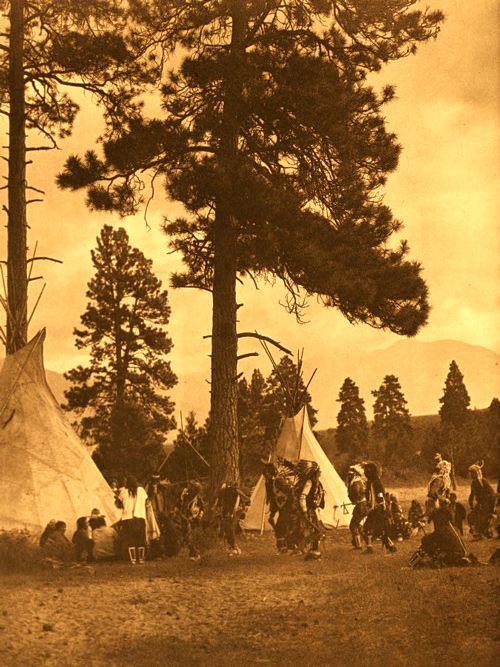
Courtesy Northwestern University Library, Edward S. Curtis’s ‘The North American Indian’: the Photographic Images.
The “Eoote-lash-Schute”
They Call themselves Eoote-lash-Schute [Salish] and consist of 450 Lodges in all and divided into Several bands on the heads of the Columbia river & Missouri, Some low down the Columbia River
—William Clark
Flathead Salish Council
we assembled the Chiefs & warriers and Spoke to them (with much dificuely as what we Said had to pass through Several languajes before it got in to theirs, which is a gugling kind of languaje Spoken much thro the Throught) we informed them who we were, where we Came from, where bound and for what purpose &c. &c.
—William Clark
The translation went from Salish (a Shoshone boy) to Shoshone (Sacagawea) to Hidatsa (Charbonneau) to French to English.
Exchanging Gifts
we made 4 Chiefs whome we gave meadels & a few Small articles with Tobacco; the women brought us a few berries & roots to eate and the Principal Chief a Dressed Brarow [Badgers], otter & two Goat & antilope [pronghorn] Skins
—William Clark
Trading for Horses
in the Course of the day I purchased 11 horses & exchanged 7 for which we gave a fiew articles of merchendize. those people possess ellegant horses.—
—William Clark
Ross’ Hole near Sula, Montana
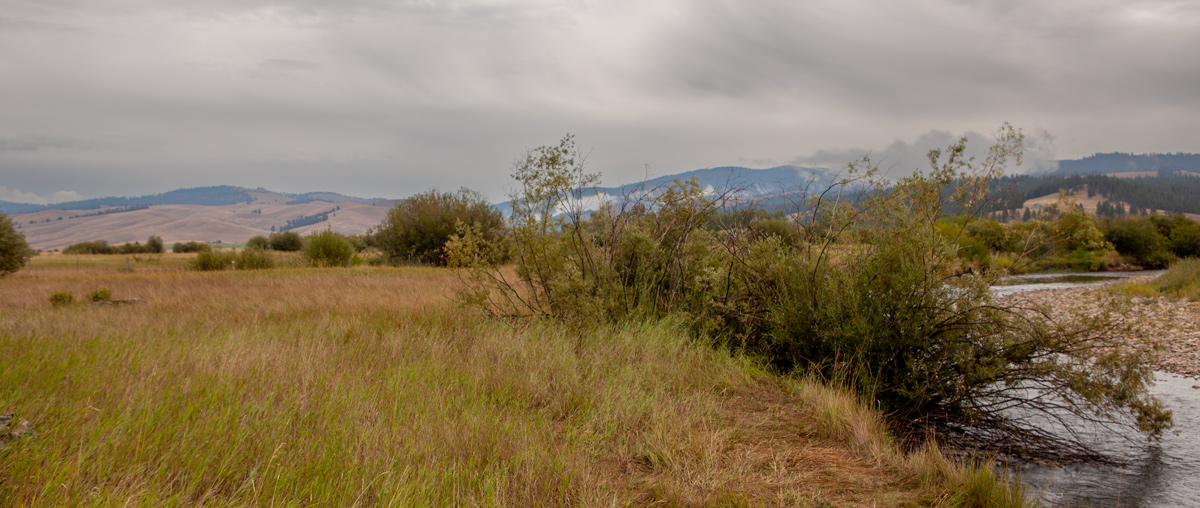
© 5 September 2013 by Kristopher K. Townsend. Permission to use granted under the Creative Commons Attribution-Share Alike 4.0 International license.
Weather Diary
State of the Thermometer at rise
Weather at Wind at State of the Thermometer at 4 P.M. Weather at 4 P.M. Wind at 4 P.M. 17 [above 0] cloudy after snow N E. 29 [above 0] cloudy after rain & snow N E Ground Covered with Snow.
—Meriwether Lewis[3]To assist the reader, the editor of this web page has omitted the date column and spelled out some abbreviations.


Ross Hole is a High Potential Historic Site along the Lewis and Clark National Historic Trail managed by the U.S. National Park Service. On US Highway 93, at the Sula Country Store, a road-side pull-off provides views of the valley and interpretive signs.
Notes
| ↑1 | Originally aired weekdays by Yellowstone Public Radio during the Bicentennial observance of 2003-2006. Narrated by Hal Hansen. Scripts by Whit Hansen and Ed Jacobson. Produced by Leni Holliman. © 2003 by Yellowstone Public Radio. |
|---|---|
| ↑2 | Originally aired weekdays by Yellowstone Public Radio during the Bicentennial observance of 2003-2006. Narrated by Hal Hansen. Scripts by Whit Hansen and Ed Jacobson. Produced by Leni Holliman. © 2003 by Yellowstone Public Radio. |
| ↑3 | To assist the reader, the editor of this web page has omitted the date column and spelled out some abbreviations. |
Experience the Lewis and Clark Trail
The Lewis and Clark Trail Experience—our sister site at lewisandclark.travel—connects the world to people and places on the Lewis and Clark Trail.
This page was funded in part by the Lewis and Clark National Historic Trail, U.S. National Park Service.
Discover More
- The Lewis and Clark Expedition: Day by Day by Gary E. Moulton (University of Nebraska Press, 2018). The story in prose, 14 May 1804–23 September 1806.
- The Lewis and Clark Journals: An American Epic of Discovery (abridged) by Gary E. Moulton (University of Nebraska Press, 2003). Selected journal excerpts, 14 May 1804–23 September 1806.
- The Lewis and Clark Journals. by Gary E. Moulton (University of Nebraska Press, 1983–2001). The complete story in 13 volumes.
This site is provided as a public service by the
Lewis and Clark Trail Alliance
with additional funding from the following: