On or near this day, Lewis, Clark, and the Osage and Mandan delegates[1]For the delegations traveling with Lewis and Clark on this day, see The Osage Delegations and Sheheke’s Delegation. leave Vincennes for Louisville. They follow ancient buffalo traces leading across the Great Marsh likely camping near the White River crossing. Earlier travelers recorded their experience navigating this cypress swamp created by the Deshee River.
Cypress Swamp
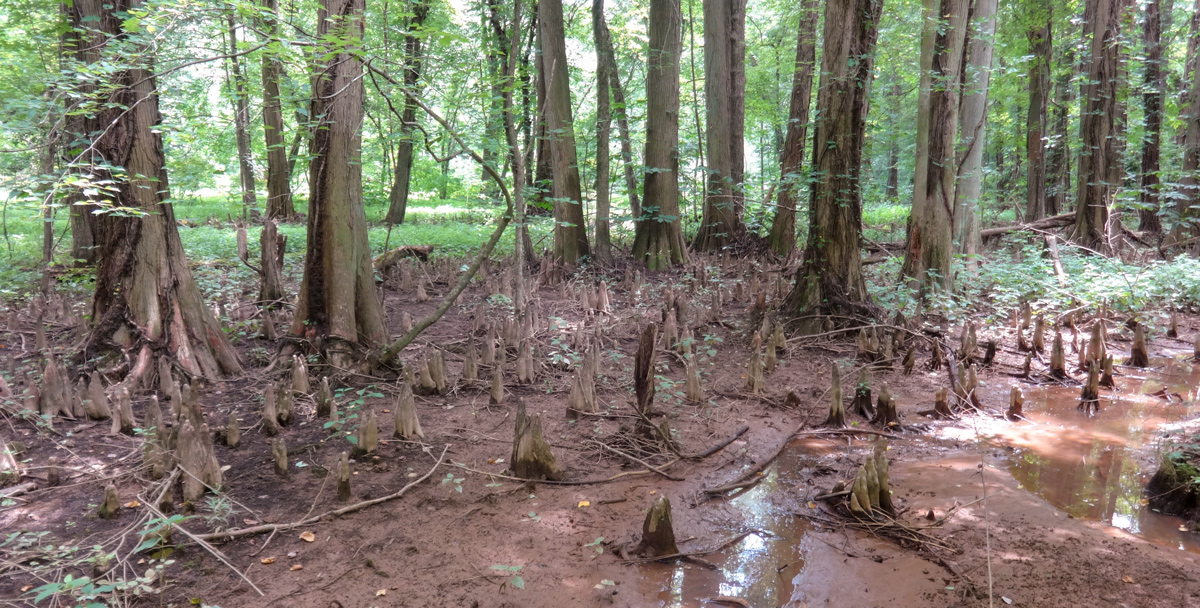
By WikiCommons user Bohemian Baltimore. Permission to use granted under the Creative Commons Attribution-Share Alike 4.0 International license.
Because much of Indiana’s cypress swamps have been replaced with farmland, the above photo is only representative of how the Great Marsh may have appeared 1806. Shown here is Battle Creek Cypress Swamp located on Maryland’s western shore and one of the northernmost stands of bald cypress trees in North America.
John Filson in 1786
In an attempt to avoid any encounters with Indiana Tribes, early settler and historian John Filson chose a difficult route under cover of darkness:
. . . we agreed to leave the Post in the night of the twelfth of June. The moon shone with an agreeable lustre, and accompanied a small distance by some of our most valuable friends, we directed our course for the falls of ohio ; and during the nocturnal hours traveled about fifteen miles: Although every step was disagreeable through brushy woods, and swampy grounds, yet safety from savages, afforded us some pleasure: next day rafted over White river. . . .
—John Filson, June 1786[2]Reuben T. Durrett, John Filson:The First Historian of Kentucky (Louisville, Kentucky: John P. Morton & Co., 1884), 65, archive.org/details/johnfilsonfirsth00durr_0.
André Michaux in 1795
On 21 January 1793, Thomas Jefferson on behalf of the American Philosophical Society presented André Michaux an official subscription to lead an expedition as far as the Western Sea. That expedition never materialized, but his desire to botanize led him through the Great Marsh on his way to Vincennes:[3]See André Michaux: The man and his ‘almost expedition’ by Lee A. Dugatkin.
On the day of our arrival we crossed a River about 20 miles before reaching Post Vincennes and although the Waters were then very low we were on the point of making a Raft for the Country is not inhabited along this Road. Of all the Journeys I have made in America in the past 10 years this is one of the most difficult owing to the quantity of Trees overturned by storms, to the thick brushwood through which one is obliged to pass; to the numbers of Flies by which one is devoured, etc.
—André Michaux, August 1795[4]Journal of André Michaux, 1793-1796 (Cleveland, Ohio: A.H. Clark Co., 1904), 66–67, archive.org/details/journalofandrm00michrich/.
Notes
| ↑1 | For the delegations traveling with Lewis and Clark on this day, see The Osage Delegations and Sheheke’s Delegation. |
|---|---|
| ↑2 | Reuben T. Durrett, John Filson:The First Historian of Kentucky (Louisville, Kentucky: John P. Morton & Co., 1884), 65, archive.org/details/johnfilsonfirsth00durr_0. |
| ↑3 | See André Michaux: The man and his ‘almost expedition’ by Lee A. Dugatkin. |
| ↑4 | Journal of André Michaux, 1793-1796 (Cleveland, Ohio: A.H. Clark Co., 1904), 66–67, archive.org/details/journalofandrm00michrich/. |
Experience the Lewis and Clark Trail
The Lewis and Clark Trail Experience—our sister site at lewisandclark.travel—connects the world to people and places on the Lewis and Clark Trail.
Discover More
- The Lewis and Clark Expedition: Day by Day by Gary E. Moulton (University of Nebraska Press, 2018). The story in prose, 14 May 1804–23 September 1806.
- The Lewis and Clark Journals: An American Epic of Discovery (abridged) by Gary E. Moulton (University of Nebraska Press, 2003). Selected journal excerpts, 14 May 1804–23 September 1806.
- The Lewis and Clark Journals. by Gary E. Moulton (University of Nebraska Press, 1983–2001). The complete story in 13 volumes.
This site is provided as a public service by the

Lewis and Clark Trail Alliance
with additional funding from the following: