In his book Jeffersonian America, British diplomat Augustus Foster describes the reactions of the Mandans during a rope dance performance at the Washington City theater. Also in attendance are five Osage delegates and Meriwether Lewis who gives a nod of approval when they ask to perform the Calumet dance.
The Waltz by Mr. Saqui (c. 1815)
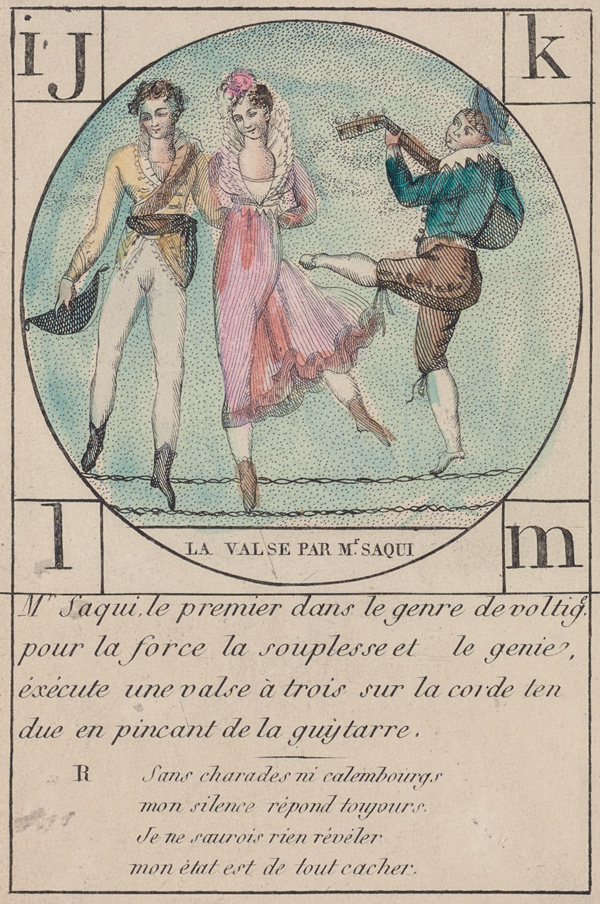
Courtesy New York Public Library Digital Collections.[1]Jerome Robbins Dance Division, The New York Public Library. “Rope dancing” New York Public Library Digital Collections, … Continue reading
The above engraving is from a series of alphabet cards. Mr. Saqui is likely Jean-Julien-Pierre Saqui who married the celebrated rope-dancer Marguerite-Antoinette Lalanne in 1805. They performed in Europe, primarily in France.[2]“Madame Saqui”, Wikipedia, en.wikipedia.org/wiki/Madame_Saqui accessed 10 January 2026. The card reads:
Mr. Saqui, the first in the art of acrobatics,
for his strength, flexibility, and genius,
performs a waltz for three on the tightrope
while playing the guitar.
Without riddles or puns,
my silence always answers.
I cannot reveal anything;
my duty is to conceal everything.[3]Original French translated by translate.google.com.
Rope Dance
On the 29th they went to the theatre to see the rope dancing at which they were exceedingly delighted, though the Mandan endeavoured as much as he could to hide his laughter pulling and pinching his cheeks and chin but all in vain, while the squaws grinned and giggled during the whole of the performance, the interpreter’s wife observing to her husband that certainly the dancing girls who twisted themselves into a thousand contortions must have had their bones taken out of them when they were children. When any feat very marvellous indeed was exhibited she made use of an exclamation which her husband translated as meaning “that is great effect of medicine”. She supposed a spirit must be in the dancers, good or bad, to enable them to tumble about so actively.
War Dance
As an interlude to the performance the savages were prevailed upon to dance . . . . four came forward with tomahawks and swords hacking the air as if fighting in close battle. When they ran in, the war whoop, or rather a frightful yell, was uttered by all. The drum still beating, the war whoop was repeated and renewed at intervals during their manoeuvres, and I distinctly caught the same sounds uttered by them at the end of the entertainment as the Osages made on entering Washington last year and passing by the President’s House. It is therefore I presume their song of joy and triumph.
Calumet Dance
They afterwards sent to know of Captain Lewis if they should dance the Calumet dance which was agreed to and the same drum continued beating when two pipes were introduced, ornamented with tassels hanging down from them made of porcupine quills.[4]Augustus John Foster, Jeffersonian America: Notes on the United States of America, ed. Richard Beale Davis, ed. (San (Marino, California: Huntington Library, 1954), 28–29, available at … Continue reading
Notes
| ↑1 | Jerome Robbins Dance Division, The New York Public Library. “Rope dancing” New York Public Library Digital Collections, digitalcollections.nypl.org/items/f7920350-f02f-0132-014e-58d385a7b928 accessed 10 January 2026. |
|---|---|
| ↑2 | “Madame Saqui”, Wikipedia, en.wikipedia.org/wiki/Madame_Saqui accessed 10 January 2026. |
| ↑3 | Original French translated by translate.google.com. |
| ↑4 | Augustus John Foster, Jeffersonian America: Notes on the United States of America, ed. Richard Beale Davis, ed. (San (Marino, California: Huntington Library, 1954), 28–29, available at archive.org/details/jeffersonianamer0000fost/. |
Experience the Lewis and Clark Trail
The Lewis and Clark Trail Experience—our sister site at lewisandclark.travel—connects the world to people and places on the Lewis and Clark Trail.

Discover More
- The Lewis and Clark Expedition: Day by Day by Gary E. Moulton (University of Nebraska Press, 2018). The story in prose, 14 May 1804–23 September 1806.
- The Lewis and Clark Journals: An American Epic of Discovery (abridged) by Gary E. Moulton (University of Nebraska Press, 2003). Selected journal excerpts, 14 May 1804–23 September 1806.
- The Lewis and Clark Journals. by Gary E. Moulton (University of Nebraska Press, 1983–2001). The complete story in 13 volumes.
This site is provided as a public service by the

Lewis and Clark Trail Alliance
with additional funding from the following: