At Fort Mandan, Sgt. Ordway sends two men to Mitutanka to trade for corn and beans. Pvt. Joseph Field kills two buffalo, and a trader from the North West Company comes to collect one of Charbonneau‘s horses.
Temperatures Keep Dropping
by Yellowstone Public Radio[1]Originally aired weekdays by Yellowstone Public Radio during the Bicentennial observance of 2003-2006. Narrated by Hal Hansen. Scripts by Whit Hansen and Ed Jacobson. Produced by Leni Holliman. © … Continue reading
Knife River Village National Historic Site
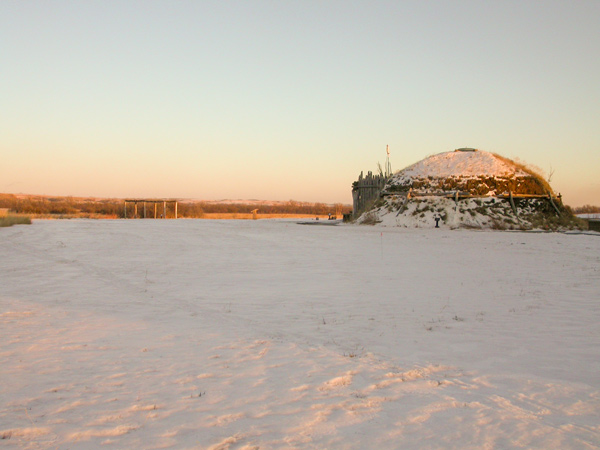
Courtesy U.S. National Park Service.
A Fine Day
The Thermotr. Stands this morning at 20° below 0, a fine day. find it imposible to make an Observation with an artifical Horsison Joseph Fields kill a Cow and Calf to day one mile from the fort
—William Clark
Corns and Beans
2 of my mess went up to the 1st village of the Mandans to day and bought Some corn and beans with a little paint and a fiew rings &.C.
—John Ordway
Mr. Morrison Visits
one of the men belonging to the N. W. Compy. came down from the Grovantares [Hidatsa] upper village to See us.
—John Ordway
Spoke to Charbonneau about his debt telling him that as he had two horses, he might send one in part payment &c. He consented, & Early in the morning I sent [William] Morrison to Fort Mandan for the horse, Wrote a few lines to Capt. Lewis & to Mr. McK.
—François-Antoine Larocque[2]W. Raymond Wood and Thomas D. Thiessen, Early Fur Trade on the Northern Plains: Canadian Traders among the Mandan and Hidatsa Indians, 1738–1818 (Norman: University of Oklahoma Press, 1985), 142.
Weather Diary
Ther. at rise
Weather Wind at Thert. at 4 P.M. Weather Wind at 4 P.M. River 20 below fair S. E. 4 cloudy S. E. —Meriwether Lewis[3]To assist the reader, the editor of this web page has omitted the date column, merged the “River” columns, and spelled out some abbreviations.


Fort Mandan is a High Potential Historic Site along the Lewis and Clark National Historic Trail managed by the U.S. National Park Service. The North Dakota Department of Parks and Recreation manages a modern reconstruction and the Lewis and Clark Interpretive Center located at US Hwy 83 and ND Hwy 200A.
Knife River Indian Villages National Historic Site is a High Potential Historic Site along the Lewis and Clark National Historic Trail managed by the U.S. National Park Service. A unit of the National Park System, the site is located at 564 County Road 37, one-half mile north of Stanton, North Dakota. It has exhibits, trails, and a visitor center.
Notes
| ↑1 | Originally aired weekdays by Yellowstone Public Radio during the Bicentennial observance of 2003-2006. Narrated by Hal Hansen. Scripts by Whit Hansen and Ed Jacobson. Produced by Leni Holliman. © 2003 by Yellowstone Public Radio. |
|---|---|
| ↑2 | W. Raymond Wood and Thomas D. Thiessen, Early Fur Trade on the Northern Plains: Canadian Traders among the Mandan and Hidatsa Indians, 1738–1818 (Norman: University of Oklahoma Press, 1985), 142. |
| ↑3 | To assist the reader, the editor of this web page has omitted the date column, merged the “River” columns, and spelled out some abbreviations. |
Experience the Lewis and Clark Trail
The Lewis and Clark Trail Experience—our sister site at lewisandclark.travel—connects the world to people and places on the Lewis and Clark Trail.
This page was funded in part by the Lewis and Clark National Historic Trail, U.S. National Park Service.
Discover More
- The Lewis and Clark Expedition: Day by Day by Gary E. Moulton (University of Nebraska Press, 2018). The story in prose, 14 May 1804–23 September 1806.
- The Lewis and Clark Journals: An American Epic of Discovery (abridged) by Gary E. Moulton (University of Nebraska Press, 2003). Selected journal excerpts, 14 May 1804–23 September 1806.
- The Lewis and Clark Journals. by Gary E. Moulton (University of Nebraska Press, 1983–2001). The complete story in 13 volumes.
This site is provided as a public service by the
Lewis and Clark Trail Alliance
with additional funding from the following: